
 On November 27, 2017, the Chaplaincy of St. Pope John Paul II in Talisay, Hilongos, Southern Leyte, was elevated the rank of Quasi-Parish, with a new name Miraculous Medal Parish.
According to the Canon Law:
A Parish is defined as a certain community of the Christian faithful stably constituted in a particular church, whose pastoral care is entrusted to a pastor (parochus) as its proper pastor under the authority of the diocesan bishop (Can. 515 §1). This canonical definition expresses the important elements of a parish as follows;
1. It is a community of the Christian faithful. The sacred church building does not constitute alone a parish but rather the Christian Faithful that has been called together to be nourished and to bear witness the Word of God in the community.
2. It is territorial in nature belonging to a particular church which is the diocese. Hence it does not act as an autonomous entity. It follows certain ecclesiastical boundaries in order to establish the competence of the pastor and to give convenience to the faithful.
3. It should have a proper pastor who is in charge of the pastoral care of the faithful. He should see to it that Christian faithful are well guided and nourished with the Joy of the Gospel through the pastoral and spiritual programs of the parish.
4. The pastor acts under the authority of the diocesan bishop. The pastor should always maintain his good relationship with his bishop. He should never make any decision nor action that are in contrary to the statutes and practices of the diocese especially in terms of legal matters.
Unless the law provides otherwise, a quasi-parish is equivalent to a parish; a Quasi-Parish is a definite community of the Christian faithful in a particular church, entrusted to a priest as its proper pastor but not yet erected as a parish because of particular circumstances (Can. 516 §1). The definition of the quasi-parish almost follows the same important elements as that of a parish, though it is not yet decreed as such for some pastoral reasons. It is temporary in nature for it may be a preparatory stage for a parish, if all the requirements and conditions prescribed by the diocesan bishop, through his prudent judgment, had been fulfilled.


The “Decree of Establishment”, signed by the Bishop of Maasin, Most Rev. Precioso D. Cantillas, SDB, DD, was read at the beginning of the Holy Eucharist by the Chancellor of the Diocese Fr. Alexes Villarubin, JCL. The concelebrated Mass was presided by Msgr. Oscar A. Cadayona, the Vicar General from Maasin. Among the concelebrants were Msgr. Antonio M. Gaviola, PC, the Pastor – Moderator of Hilongos Parish, Fr. Conrado C. Saavedra, Jr., Fr. Francis Pupkowski, SCJ, Fr. Joseph Butlig, SCJ, Fr. Patrick Gutib, SCJ, Fr. Arthur Guevara, SCJ and Fr. Christopher Alburo, SCJ.


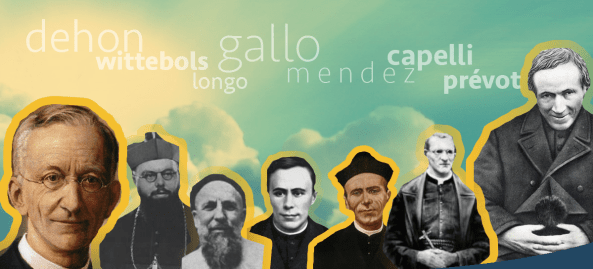 Each November 26 is a special day of remembrance of all SCJs who have died in the field as martyrs. Since November 26 this year falls on Sunday, the SCJ community in Cagayan de Oro celebrated the SCJ Memorial Day on November 25, 2017. The main celebrant and homilist was superior of the community Fr. Patrick Gutib, SCJ. The celebration was attended by the SCJs from the area of Cagayan de Oro, members of the Dehonian Family and friends. At the end of the Holy Mass took place a 10 minute presentation about the SCJ martyrs. As usual the celebration concluded with a common meal.


 On November 20, 2017, seven (7) SCJ scholastics were installed to the ministry of Lector. Three (3) of them belong to the SCJ Philippines Region and four (4) to the District of Vietnam.


 SCJ Philippines Region