
“I am the resurrection and the life; whoever believes in me, even if he dies, will live.”
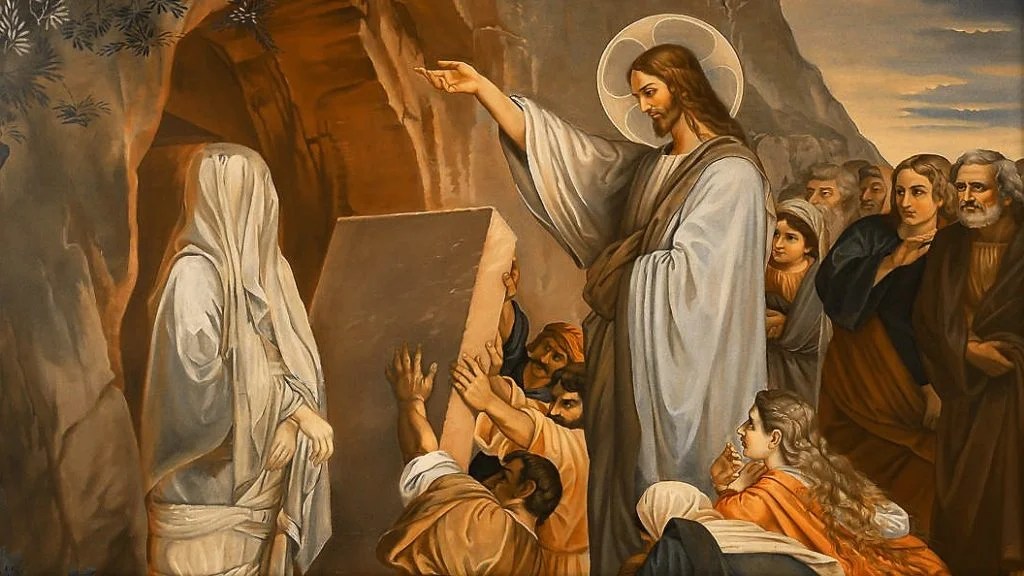
The Gospel presents the moving story of the raising of Lazarus. It is not only a miracle story; it is a revelation of the heart of Christ and a call to faith. Jesus arrives at Bethany after Lazarus has already been in the tomb four days. Human hope seems finished. Martha speaks honestly: “Lord, if you had been here, my brother would not have died.” Her words express both sorrow and faith. She believes, yet she struggles. Many believers know this experience. We pray, we trust, yet we also question.
Jesus does not rebuke her. Instead, He leads her deeper: “Your brother will rise.” When Martha answers with a general belief in the resurrection at the last day, Jesus brings the truth into the present moment: “I am the resurrection and the life.” Faith is not only belief in a future event; it is a relationship with a living Person. Eternal life begins now when one trusts Him.
The shortest verse of the Gospel follows: “Jesus wept.” This simple sentence reveals the compassion of the Lord. God is not distant from human pain. He enters it. He shares it. He stands before the tomb of His friend and weeps. This teaches us that tears are not a lack of faith. They can be an expression of love. Christ’s tears assure us that no suffering is ignored by God.
Then comes the command: “Take away the stone.” The stone is a powerful image. It represents obstacles that keep life locked in death—sin, fear, resentment, despair, or habits we refuse to change. Often we ask God to give us new life, but we hesitate to remove the stones. Yet Jesus invites cooperation. Grace does not destroy our freedom; it calls it into action.
Finally, Jesus cries out: “Lazarus, come out!” The dead man emerges, still bound in burial cloths. Christ then tells the crowd: “Untie him and let him go.” The miracle is complete only when the community helps remove the bindings. This is also a lesson for the Church. Faith is not lived alone. We help one another to be free. Encouragement, forgiveness, and patience can loosen the bonds that still hold someone captive.
This Gospel challenges us to ask several questions. Do I truly believe that Christ is life for me now, or only an idea for the future? What stones must I allow Him to remove? Where is He calling me to help untie someone else?
As Lent approaches its final days, the Church places this Gospel before us to strengthen hope. The raising of Lazarus points toward the Resurrection of Christ and promises our own. No tomb is final when the Lord speaks. No darkness is stronger than His voice.
Let us therefore listen carefully. Perhaps He is calling our name, just as He called Lazarus. If we hear Him, let us not remain in the tomb of old ways. Let us come out into the light, trusting that the One who calls us is truly the Resurrection and the Life.
 SCJ Philippines Region