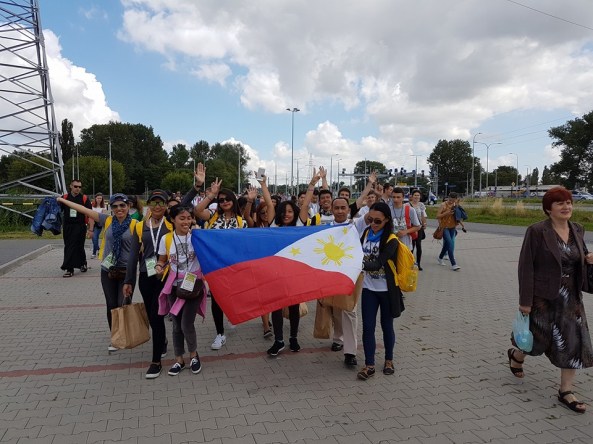
 The 31st World Youth Day in Krakow, Poland is over. In the Final Mass on July 31, 2016, at the Campus Misericordiae (Field of Mercy) in Brzegi, near Wieliczka salt mine, presided by Pope Francis participated more than 2.5 million people from 187 countries. They were accompanied by 47 cardinals, 800 bishops and 20,000 priests. The main celebration was preceded by a Prayer Vigil and Adoration of the Blessed Sacrament on July 30, 2016. Over a million young people camped out here overnight. Many spent the whole night in prayer.
The final liturgy included a reflection on a reading from the Gospel of Luke on Zacchaeus’ conversion: the short and wealthy publican who was hated by everyone in the city of Jericho, climbs up onto a tree to watch Jesus passing by and to his surprise, is invited by the Nazarene to come down. Jesus invites himself to the publican’s house, which gets everyone talking, shocked as they are at his decision to visit the home of a sinner.
In his homily, Francis spoke of three obstacles Zacchaeus had to face. The first was his smallness of stature. “Even today we can risk not getting close to Jesus because we don’t feel big enough, because we don’t think ourselves worthy. This is a great temptation; it has to do not only with self-esteem, but with faith itself.” Because, the Pope recalled, “we have been created in God’s own image; Jesus has taken upon himself our humanity and his heart will never be separated from us”. “Not to accept ourselves, to live glumly, to be negative, means not to recognize our deepest identity. It is like walking away when God wants to look at me, trying to spoil his dream for me. God loves us the way we are, and no sin, fault or mistake of ours makes him change his mind.” As far as Jesus is concerned, “no one is unworthy of, or far from, his thoughts. No one is insignificant. He loves all of us with a special love; for him all of us are important” and “God counts on you for what you are, not for what you possess. In his eyes the clothes you wear or the kind of cell phone you use are of absolutely no concern. He doesn’t care whether you are stylish or not; he cares about you! In his eyes, you are precious, and your value is inestimable”.
Francis explained to young people that “God remains faithful, even obstinate, in his love for us. The fact is, he loves us even more than we love ourselves. He believes in us even more than we believe in ourselves. He is always ‘cheering us on’; he is our biggest fan. He is there for us, waiting with patience and hope, even when we turn in on ourselves and brood over our troubles and past injuries.”
We must not grow fond of sadness, the Pope stressed. “It will do us good to pray every morning: ‘Lord, I thank you for loving me; help me to be in love with my own life!’ Not with my faults, that need to be corrected, but with life itself, which is a great gift, for it is a time to love and to be loved.”The second obstacle Zacchaeus faces is “the paralysis of shame”. “He mastered his shame, because the attraction of Jesus was more powerful. You know what happens when someone is so attractive that we fall in love with them: we end up ready to do things we would never have even thought of doing.” This too, Francis said, “is the secret of joy: not to stifle a healthy curiosity, but to take a risk, because life is not meant to be tucked away. When it comes to Jesus, we cannot sit around waiting with arms folded; he offers us life – we can’t respond by thinking about it or ‘texting’ a few words!”
“Don’t be ashamed to bring everything to the Lord in confession,” the Pope urged young people, “especially your weaknesses, your struggles and your sins. He will surprise you with his forgiveness and his peace. Don’t be afraid to say “yes” to him with all your heart, to respond generously and to follow him! Don’t let your soul grow numb, but aim for the goal of a beautiful love which also demands sacrifice. Say a firm “no” to the narcotic of success at any cost and the sedative of worrying only about yourself and your own comfort.”
The third obstacle Zacchaeus had to overcome was the grumbling of the crowd, who first blocked him and then criticised him. “How truly hard it is to welcome Jesus, how hard it is to accept a ‘God who is rich in mercy’! People will try to block you, to make you think that God is distant, rigid and insensitive, good to the good and bad to the bad. Instead, our heavenly Father demands of us real courage: the courage to be more powerful than evil by loving everyone, even our enemies.”
“People may laugh at you because you believe in the gentle and unassuming power of mercy. People may judge you to be dreamers, because you believe in a new humanity, one that rejects hatred between peoples, one that refuses to see borders as barriers and can cherish its own traditions without being self-centred or small-minded. Don’t be discouraged: with a smile and open arms, you proclaim hope and you are a blessing for our one human family, which here you represent so beautifully!”
The Pope encouraged young people not to give up in the face of “closed-mindedness” but to “seek goodness for its own sake, content to maintain a pure heart and to fight peaceably for honesty and justice. Don’t stop at the surface of things; distrust the worldly cult of appearances, cosmetic attempts to improve our looks. Instead, “download” the best “link” of all, that of a heart which sees and transmits goodness without growing weary.” And he asked that “in all the “contacts” and “chats” of each day, pride of place be given to the golden thread of prayer,” using the Gospel as a “compass”.
God’s memory is not a “‘hard disk’ that ‘saves’ and ‘archives’ all our data, but a heart filled with tender compassion, one that finds joy in “erasing” in us every trace of evil. May we too now try to imitate the faithful memory of God and treasure the good things we have received in these days.”
Full text of the homily: http://www.catholicnewsagency.com/document/homily-at-the-final-mass-at-campus-misericordia-in-brezgi-1082/?platform=hootsuite

 This year the SCJ Philippine Region was entrusted with three new pastoral areas. Because of this several SCJs for the first time became parish priests. Although they were assigned in the parishes and have some pastoral experience many things for them are new. Being an assistant to the parish priest is like sitting in the front seat, but not being a driver. According to the Canon Law “The Parish Priest is the proper pastor of the parish entrusted to him… exercising the pastoral care of the community entrusted under the authority of the diocesan Bishop, whose ministry of Christ he is called to share…” (Can. 519). The role of a Parish Priest is twofold: as an administrator and as a shepherd, who acts in the name of the local bishop and is accountable to.


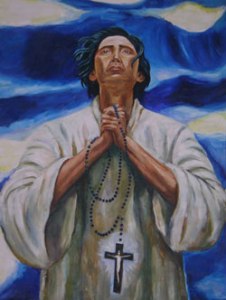 St. Lorenzo Ruiz is the first Filipino saint. He is also the first Filipino martyred for the Christian Faith. Lorenzo Ruiz was a layman, married, and had two sons and a daughter. Born in Binondo, Manila, about 1600’s, he was educated in the school of the Dominicans there. He served as an altar boy and later was a helper and clerk-sacristan in the church of Binondo. He was a member of the Confraternity of the Rosary. He made his living probably as a calligrapher, one who renders documents in beautiful penmanship for private or official use. To be sure, that work denoted an accomplished and educated person, especially at a time when many an illustrious personage were far from excelling in this art. An adverse event made him leave the Philippines in 1636.


 SCJ Philippines Region