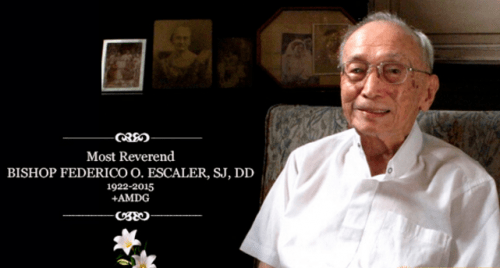
+ Bp. Federico O. Escaler, S.J., D.D.

Bp. Federico EscalerYesterday, on November 28, 2015, the former and the first Bishop of Prelature of Ipil, Most Rev. Federico O. Escaler, S.J., D.D., at the age of 93, has joined the Lord. Bp. Escaler was one of the two bishops who in 1989 accepted members of the first group of SCJs into his Prelature, entrusting them two parishes: Margosatubig (now Diocese of Pagadian) and Kumalarang (Diocese of Ipil).

All members of the SCJ Philippine Region express their gratitude for Bp. Freddy’s fatherly care and love and join the prayers in his intention. May he rest in Peace!


Biography of Bishop Federico O. Escaler, S.J., D.D. (1922-2015)
By Sch. Amado T. Tumbali, Jr., SJ
Asst. Province Archivist

The Most Reverend Federico Ocampo Escaler was born on 28 June 1922 in Manila. On his birthday in 1941, after finishing a degree in Ateneo de Manila, where he also studied his primary and secondary education, Freddy, as he had been called in the Society of Jesus, entered the Jesuits at Sacred Heart Novitiate, Novaliches. However, Freddy and his fellow novices moved to Ateneo de Manila at Padre Faura during the outbreak of WWII. They began Juniorate there on 1 June 1943 but eventually moved to La Ignaciana in Sta. Ana, and then, finally back to Novaliches. From 1945-1948, he studied and finished his M.A. in Philosophy at St. Robert Bellarmine College which was first located in La Ignaciana, and then in Novaliches. He was a regent from 1948-1951 at San Jose Seminary in La Ignaciana where he taught English, Latin, Tagalog, Spanish, Sociology, Philippine Government, and Geometry. He was also the Prefect of Discipline to the major seminarians and moderator of the Sodality, the choir, and INSTA. He studied and finished S.T.B. and S.T.L. at Woodstock College, Maryland, U.S.A. from 1951-1955. He was ordained deacon at Fordham, New York, U.S.A on 18 June 1954 by Bishop Thomas J. Feeney, S.J., D.D. and priest the following day by Francis Cardinal Spellman. From 1954-55, he did some special studies in Guidance and Counseling at Boston College and Fordham University, respectively.

After Fr. Freddy’s tertianship at Palacio del Santo Duque, Gandia, Valencia, Spain in 1956, his first assignment as a priest in the Philippines was Minister at San Jose Seminary in Highway 54. A year after, he was assigned Archivist of the Vice Province and Socius to Vice Provincial Francis Clark. In 1961, he became Superior and Minister of La Ignaciana Retreat House in Sta. Ana. While serving those competencies, he also gave retreats around the country.

In 1962, Fr. Freddy was Rector and President, while teaching Theology, at Ateneo de Davao. In 1966, he was back to Xavier House as Province Treasurer. While in Manila, he was also Chaplain of the Christian Family Movement. In 1973, he was assigned to Ateneo de Cagayan (X.U.) as Rector and President, while teaching Theology. Three years after, he was named as the first Bishop of then to be established Prelature of Kidapawan in North Cotabato. In 1976, he was ordained bishop on the feast of St. Ignatius of Loyola by Jaime Cardinal Sin at Manila Cathedral. From 1976-1980, he was in Kidapawan until his assignment to pioneer the newly created Prelature of Ipil in Zamboanga Sibugay, where he dedicated himself for 17 years until his retirement on his birthday in 1997. Those indeed were tough years, including his first episcopal assignment. “Ipil and Kidapawan were hotbeds of conflict during the time,” as writer Christian Dy describes. Indeed, in 1985, Bishop Freddy was kidnapped and in 1995, another group of armed militants torched Ipil and left at least 53 dead.

Back in Manila, he continued pastoral work as Spiritual Director of Buklod ng Pag-ibig, Chaplain of A.I.M. and the Cenacle Prayer Group. Towards the end of 2015, a mass was discovered in his liver for which he declined further intervention. He died on 28 November 2015 in his family ancestral residence in San Miguel, Manila.

(http://www.phjesuits.org/portal/bishop-federico-o-escaler-s-j-d-d-1922-2015/)
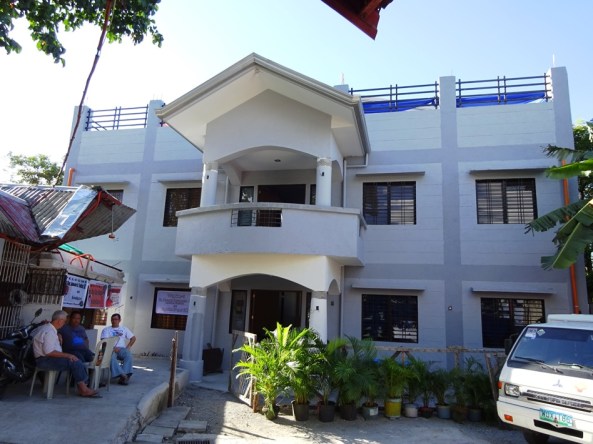
 

Blessing of New Parish House in Bagong Silang

DSC00826The San Roque Parish Phase 9 in Bagong Silang, Caloocan City is being run by the SCJs for more than four years. The parish is a part of Santo Niño Vicariate and it belongs to the Diocese of Novaliches. At the moment the parish is being served by three SCJ priests: Fr. John Karl Cabaluna, Fr. Elpidio Luza, Jr., Fr. Christopher Alburo and one seminarian on exposure Bro. Alex Jumawid. It is located in very densely populated area with a little space for the parish church and some parish facilities. The access road is very narrow and not accessible to trucks or bigger vehicles. The whole area is covered with little, very close to each other, houses, a kind of squatter place inhabited by the very poor who have no access to tenured land of their own.

Among the different ministries and activities such as Lay Ministers, Catechists, Youth, Altar Servers, Legion of Mary, the parish has one of the strongest BEC (Basic Ecclesial Communities) Program in the whole diocese. Also, the parish, with the initiative and support of the Parish Priest, Fr. John Karl Cabaluna, scj, has organized many programs benefiting the poor, sick and homeless. One among them is the “Bath, Eat and Go Program”, where the homeless can come to the parish, take shower, have a meal and go back to their shelters. Everyday. the parish is serving more than one hundred meals and selling kilos of rice at a lower price.

In the beginning, the parish was served by Fr. John Karl from  the Dehon House, an SCJ Formation House in Quezon City, who was helped by the priests from the formation community and some seminarians. Since  four years ago, the priests assigned in San Roque Parish were living in the parish, first in the rented house and later on in a temporary, very simple and perishable hut, with no privacy and basic facilities.

To have a decent place, where the priests could rest, pray together and feel safe, was not only a dream of the priests assigned there, but also of the parishioners and the SCJ Congregation.

Finally, the dreams came true on November 7, 2015, when the new parish house was completed and blessed by Most Rev. Antonio R. Tobias, DD. The SCJs in Bagong Silang got their new house, fruit of cooperation between the priests, parishioners, the Diocese of Novaliches and the Philippine Region of the Priests of the Sacred Heart of Jesus (SCJ).

The blessing was preceded by the raffle draw with motorcycle as the first prize.

Congratulations to the winners, to the SCJ priests and all parishioners!

Congratulations to the New SCJ Bishop!

On Sunday, October 25, José Ornelas Carvalho, former superior general of the Priests of the Sacred Heart, was ordained and installed as bishop of the Diocese of Setúbal in his native Portugal. Joining the diocese in the celebration were Dehonians from around the world, including several bishops, as well as family and fellow bishops and priests of Portugal.


World Mission Sunday 2015

World Mission Sunday, organized by the Propagation of the Faith, is a day set aside for Catholics worldwide to recommit themselves to the Church’s missionary activity through prayer and sacrifice.  In 2015, World Mission Sunday is celebrated on October 18.

Annually, World Mission Sunday is celebrated on the next-to-last Sunday in October. As described by Pope John Paul II, World Mission Sunday is “an important day in the life of the Church because it teaches how to give: as an offering made to God, in the Eucharistic celebration and for all the missions of the world” (see Redemptoris Missio 81).

Pope John Paul II has also spoken of the Propagation of the Faith’s General Fund of support, calling this a “central fund of solidarity.” In a message delivered on a recent World Mission Sunday, the Pope said: “The offerings that will be collected [on World Mission Sunday] are destined for a common fund of solidarity distributed, in the Pope’s name, by the Society for the Propagation of the Faith among the missions and missionaries of the entire world.”

Every year the needs of the Catholic Church in the Missions grow – as new dioceses are formed, as new seminaries are opened because of the growing number of young men hearing Christ’s call to follow Him as priests, as areas devastated by war or natural disaster are rebuilt, and as other areas, long suppressed, are opening up to hear the message of Christ and His Church. That is why the involvement and commitment of Catholics from around the world is so urgently needed. Offerings from Catholics in the United States, on World Mission Sunday and throughout the year, are combined with offerings to the Propagation of the Faith worldwide.

Mission dioceses – about 1,100 at this time – receive regular annual assistance from the funds collected. In addition, these mission dioceses submit requests to the Congregation for the Evangelization of Peoples for assistance, among other needs, for catechetical programs, seminaries, the work of Religious Communities, for communication and transportation needs, and for the building of chapels, churches, orphanages and schools. These needs are matched with the funds gathered in each year. The world’s national directors of the Propagation of the Faith vote on these requests, matching the funds available with the greatest needs. These funds are then distributed, in their entirety, to mission dioceses throughout the world.

By scjphil Posted in Church

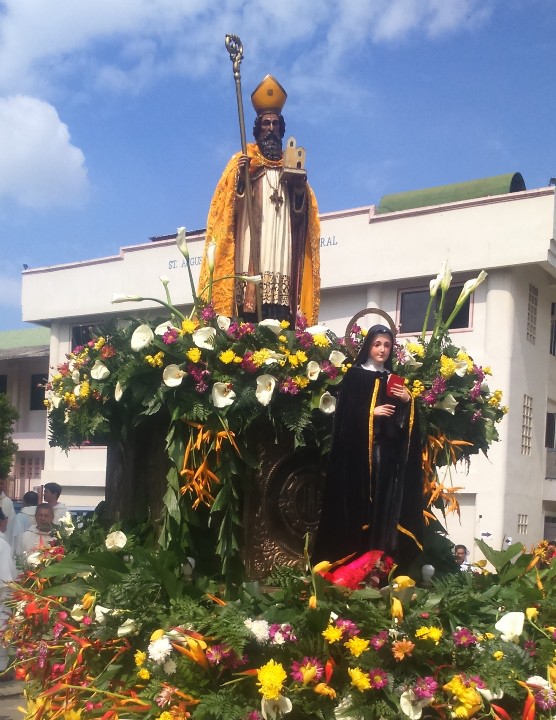
St. Augustine – Patron Saint of Cagayan de Oro

St AugustineSt. Augustine was born at Tagaste November 13, 354 at Tagaste, Numidia, North Africa (Souk-Ahras, Algeria) as Aurelisu Augustinus.  His father was a pagan who converted on his death bed; his mother was Saint Monica, a devout Christian.  He received a Christian upbringing and in 370 went to the University at Carthage to study rhetoric with a view to becoming a lawyer.  He gave up law to devote himself to literary pursuits and gradually abandoned his Christian faith, taking a mistress with whom he lived fifteen years and who bore him a son, Adeodatus, in 372.  After investigating and experimenting with several philosophies, he became a Manichaean for several years; it taught of a great struggle between good and evil, and featured a lax moral code.  A summation of his thinking at the time comes from his Confessions: “God, give me chastity and continence – but not just now.”  In 384, he accepted the chair of rhetoric at Milan, and of his tutor, Simplicianus, he returned to his Christian faith and was baptized on Easter Eve 387.  On the death of his mother he returned to Africa, sold his property, gave the proceeds to the poor, and founded a sort of monastery at Tagaste.  He was ordained in 390 and moved to Hippo where he established a community with several of his friends who had followed him.  Five years later he was consecrated Bishop and made coadjutor to Valerius, Bishop of Hippo, whom he succeeded in the following year. Augustine became the dominant figure in African Church affairs and was the leader in the bitter fights against Manichaeism, Donatism, Pelagianism and other heresies.  Augustine’s towering intellect molded the thought of Western Christianity to such an extent that his years after his death.  He wrote profusely, expositing and defending the faith, and to this day many of his two hundred treatises, some three hundred sermons are of major import in theology and philosophy.  Among his best best-known works are his Confessions; City of God, a magnificent exposition of a Christian philosophy of history; De Trinitate; De Doctrina Christiana; Enchiridion; and his treatises against the Manichaeans and the Pelagians.  His later thinking can be summed up in a line from his writings: “Our hearts were made for You, O Lord, and they are restless until they rest in you.”  Called Doctor of Grace, he is one of the greatest of the Fathers and Doctors of the Church, and with the possible exception of Thomas Aquinas, the greatest single intellect the Catholic Church has ever produced.