
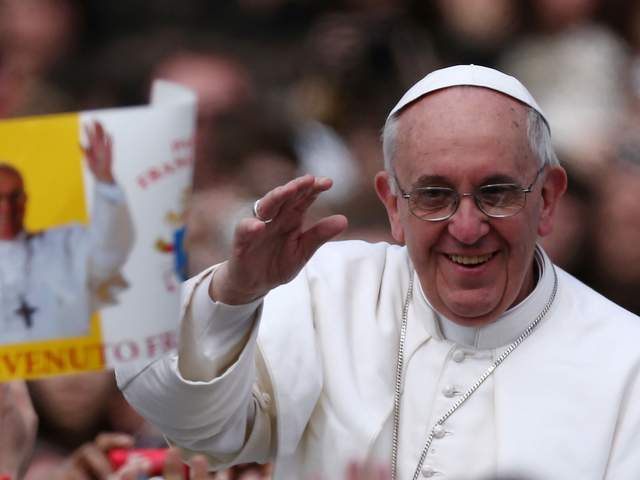
 In his message for the 48th World Communications Day, the Pope stressed the ever vital role of communication to humanity. His focus is summed up in the question “And who is my neighbor?”, as we can look at communication in terms of our being “neighborly”. In these modern times, he particularly focuses on globalization and the developments in travel and communications technology, which seemed to make it easier for people to be neighbors. The Pope also gave credit to the Internet as one of the unprecedented technological advances by mankind, which “offers immense possibilities for encounter and solidarity. “
But although this digital age have contributed significantly in terms of bringing people closer together, there still exists this “ scandalous gap between the opulence of the wealthy and the utter destitution of the poor”, as Pope puts it. The speed of the information transmitted relatively exceeds our capacity to reflect and decide, which impedes our proper self-expression. He said that with the digital media, we are exposed to various opinions, but it also enables us to be selective about the information that confirms our own wishes, ideas and interests. He notes that there are still people who lack access to this communication advancement, and therefore run the risk of being left behind.
Pope Francis then challenges us to be reminded of the parable of the Good Samaritan. It is not enough for the Samaritan to go near the man he finds half-dead on the side of the road, he also takes responsibility for him. Similarly, in order for us to be a good neighbor, “it is not enough to be passersby on the digital highways, simply “connected”; connections need to grow into true encounters.” We need to be personally engaged, “as this digital highway is teeming with people who are often hurting, men and women looking for salvation and hope.” By means of the internet, the church doors are kept open so that people can enter and the Gospel can reach everyone.
He qualifies an effective Christian witness as someone who does not bombard people with religious messages, but is in encounter with others in an effort to willingly dialogue on their doubts and questions. To dialogue, means to believe the “other” has something worthwhile to say, and to entertain his or her point of view and perspective without renouncing our own ideas and traditions.
In conclusion, Pope Francis referred back to the Good Samaritan, where the wounds of the injured man were tended with oil and wine. Our communications will then be “a balm which relieves pain and a fine wine which gladdens hearts. May the light we bring to others not be the result of cosmetics or special effects, but rather of our being loving and merciful neighbors to those wounded and left on the side of the road.”
The Holy Father’s message is entitled Communication at the Service of an Authentic Culture of Encounter and is traditionally published coinciding the Memorial of St. Francis de Sales, patron saint of writers. The 48th World Communications Day also falls on Ascension Sunday, June 1, 2014.
Category Church
Bishops appeal for Zamboanga aid
Bishops appeal for Zamboanga aid.
 The country’s Catholic bishops issued an appeal for humanitarian aid in Zamboanga on Tuesday as the southern Philippine city looked to recover from three weeks of fighting between government troops and Muslim rebels.
“We call on your help to sustain the Church’s aid, and together bring the Christian message of love and peace to our brothers and sisters in need,” said Bishop Broderick Pabillo, chairman of the social action secretariat of the bishops’ conference.
The prelate said the fighting between the military and Moro National Liberation Front (MNLF) fighters had a “devastating impact” on the people.
At least 200 people – including rebels, security forces and civilians – have been killed in the fighting. The government declared that “the worst is over” at the weekend but that sporadic fighting is still taking place.
The needs of more than 100,000 displaced people will continue to rise each day while homes and communities are rebuilt over the next three months, Pabillo said.
Authorities say some 10,000 homes were lost during the fighting and estimated losses to business have been pegged at about US$115 million.
The National Secretariat for Social Action of the Bishops’ Conference of the Philippines has so far provided a $2,300 initial contribution to Zamboanga archdiocese’s relief efforts.
The archdiocese is currently catering to the needs of some 18,736 evacuees in 11 Church-run evacuation centers.
Pabillo said the situation in the centers varies, adding that at least seven of the facilities have kitchens, but the rest have no provision for cooking.
The government’s social welfare office yesterday announced that it has set aside $2.3 million for “food assistance, non-food items, financial assistance, cash-for-work in the operation of community kitchens, hygiene and sanitation, and meal distribution” in the city.
Canonization date announced for Blessed Popes John Paul II and John XXIII

Canonization date announced for Blessed Popes John Paul II and John XXIII.
(Vatican Radio) Pope Francis on Monday morning held the Public Ordinary Consistory for the forthcoming Canonization of Blessed Pope John XXIII and Blessed Pope John Paul II. During the course of the Consistory in the Vatican’s Consistory Hall, the Pope decreed that his two predecessors will be raised to Sainthood on April 27, 2014, the day on which the Church celebrates the Second Sunday of Easter and Divine Mercy.
Mindanao prelates set day of prayer for Zambo | Sun.Star
Mindanao prelates set day of prayer for Zambo | Sun.Star.
Sunday, September 29, 2013
MEMBERS of the Catholic Bishops Conference of the Philippines (CBCP) based in Mindanao have set October 1, Tuesday, as a Day of Prayer for Peace now that the Zamboanga crisis has ended.
According to Cotabato Archbishop Orlando Quevedo, they decided to call for a day of prayer and combine it with fasting and candle lighting so that peace will stay in the strife-torn region.
“We are calling for whole day of prayers, fasting and candle lighting for peace on October 1,” said Quevedo.
The day-long activity shall culminate with candle-lighting activities held “in silence” simultaneously at 6 p.m., according to Quevedo.
On Saturday, the government announced that the crisis in Zamboanga City was over after the last remaining hostages were rescued from their Moro National Liberation Front (MNLF) captors.
The crisis, which began on September 9 when MNLF forces occupied several barangays in the city, resulted to over 200 deaths and affected over 100,000 residents.
In a related development, the CBCP urged all archdioceses and dioceses in the country to pray the old St. Michael the Archangel Prayer in a bid to counter all the negative news that have surfaced in the past few weeks.
In a circular, Cebu Archbishop Jose Palma, who is also the CBCP president, asked all churches nationwide to recite the prayer amid the recent problems of the country ranging from the Zamboanga crisis, to the pork barrel scandal, as well as natural calamities such as typhoon and flooding.
“Through this prayer, we invoke St. Michael to defend us and our country against the wickedness and snares of the evil one,” Palma said.
“Michael – which means, ‘Who is like God’ – will win over all the evil attempts to disfigure the face of mankind because God, Who is stronger, acts in him,” he added.
The Prayer to St. Michael the Archangel, which was composed by Leo XIII in 1896 but was stopped in 1964, read as follows:
“St. Michael the Archangel, defend us in battle, be our defense against the wickedness and snares of the devil; may God rebuke him we humbly pray. And do thou, O Prince of the Heavenly hosts, by the power of God, cast into hell Satan and all the other evil spirits who prowl upon the earth for the ruin of souls. Amen.” (HDT/Sunnex)
St. Lawrence Ruiz – first Filipino Saint
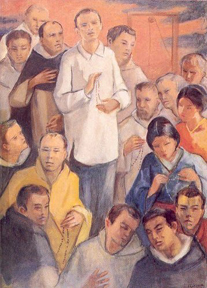
Lawrence Ruiz is the first Filipino to be canonized a saint. He and 15 others were martyred at Nagasaki, Japan in 1637. The group included two consecrated women, two other laymen, two brothers and nine priests.
Lawrence was born in Manila in the Philippines; his father was Chinese and his mother Filipino. He became associated with the Dominicans, and was a member of the Confraternity of the Holy Rosary. These Dominicans taught him Spanish, and from his parents he learned Chinese and Tagalog. He became a professional calligrapher and transcribed documents.
He married and had three children. In 1636, he fled the Philippines after being accused of murder. He joined a missionary group headed for Japan, where Catholics were being persecuted. It was soon found out that the members of this group were Catholic, so they were arrested and taken to Nagasaki. They were tortured for several days, first crushed while hanging upside down for three days, then the bodies were burned, with the ashes thrown into the Pacific Ocean on September 30, 1637. Pope John Paul II canonized these martyrs on October 18, 1987.
 SCJ Philippines Region