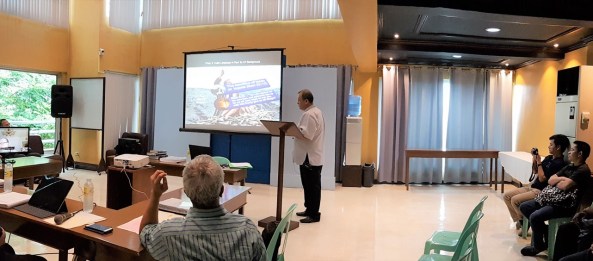
 On January 29, 2018, Fr. Delio Ruiz, SCJ, member of the Philippine Region, has defended his STD Dissertation entitled “MINISTER OF CHRIST JESUS: A Study of Cultic Language in Romans 15:14-21 in the Context of Paul’s Missionary Framework.” The Board of Examiners was composed of Fr. Renato Repole, S.J., S.T.D. (Principal Examiner), Dr. Markus Locker (Adviser), Fr. Herbert Schneider, S.J., S.T.D., and Fr. Antonio de Castro, S.J., S.T.L., E.H.D. The defense was being held in partial fulfillment of the requirements for the degree Doctorate in Sacred Theology with field of specialization in Biblical Theology.
“In this study, the author draws upon the apostle Paul’s Old Testament background and the Pharisaic Judaism’s context TRACING Paul’s use of cultic language in Romans. Cultic language in Paul’s letters does not ONLY refer to a number of terms related to the Temple services such as offering sacrifices. Paul ALSO uses cultic language outside the context of the Temple in order to explain his arguments, creating an imaginative context for his theological and ethical message (cf. Phil 4:18; Rom 12:1).
The study focuses on the letter-frame (Rom 1:1-15; 15:13-16:27), especially the closing section, the so-called “neglected endings,” where Paul explains the nature of his mission to the Gentiles (Rom 15:14-21) and his travel plans (15:22-32). An essential part of the study is that Romans 15 SHOULD not be considered merely as an appendix of the letter, and that one still can learn more of the whole letter. In view of the significance of cultic language in Romans the investigation seeks to clarify the meaning of Paul’s self-description as “ministry of Christ Jesus” and his “priestly service of the gospel” with its result, “the offering of the Gentiles” (Rom 15:16).
The use of cultic language aids Paul in defining his ministry to both Jewish and Gentiles Christians in a comprehensible and compelling manner (Rom 15:14-21). In doing so, the apostle emphasizes his appeal to fraternal relation and mutual acceptance within the believers in the house churches in Rome (15:7-13). Thus, both groups would be united in worship and communal response to the gospel (Rom 15:5-6; 15:16).” (http://lst.edu/community/news-a-features/1099-std-dissertation-oral-defense-of-fr-delio-ruiz-scj-argentina-on-29-january-2018)


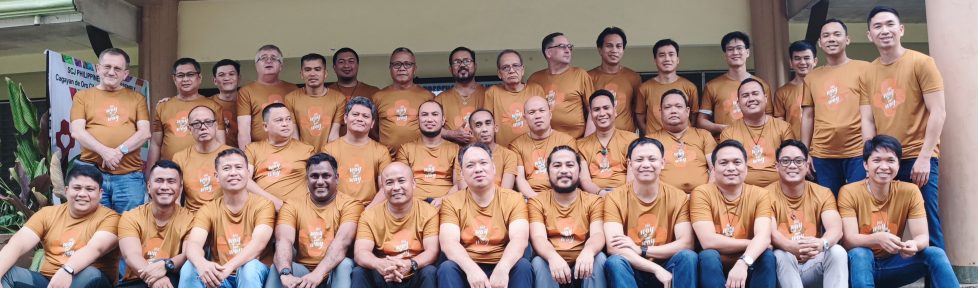
The defense, held at Tipanan ni San Ignacio, Loyola School of Theology, lasted for almost two hours and was attended by the SCJs and friends from Metro Manila, Cagayan de Oro and Macao.


Congratulations to Fr. Delio, the new Doctor in Sacred Theology!


 Heavenly Father, We thank You and praise You today for the miracle of Your Son’s birth. Thank You for bringing great JOY to the whole world! Thank You for giving us the assurance that because You came to us in the form of a human, we who believe in Jesus can know with absolute certainty that we’ll spend eternity with You.
 “God travels wonderful ways with human beings, but he does not comply with the views and opinions of people. God does not go the way that people want to prescribe for him; rather, his way is beyond all comprehension, free and self-determined beyond all proof. Where reason is indignant, where our nature rebels, where our piety anxiously keeps us away: that is precisely where God loves to be. There he confounds the reason of the reasonable; there he aggravates our nature, our piety—that is where he wants to be, and no one can keep him from it. Only the humble believe him and rejoice that God is so free and so marvelous that he does wonders where people despair, that he takes what is little and lowly and makes it marvelous. And that is the wonder of all wonders, that God loves the lowly…. God is not ashamed of the lowliness of human beings. God marches right in. He chooses people as his instruments and performs his wonders where one would least expect them. God is near to lowliness; he loves the lost, the neglected, the unseemly, the excluded, the weak and broken.” ― (Dietrich Bonhoeffer, God Is in the Manger: Reflections on Advent and Christmas).
 SCJ Philippines Region