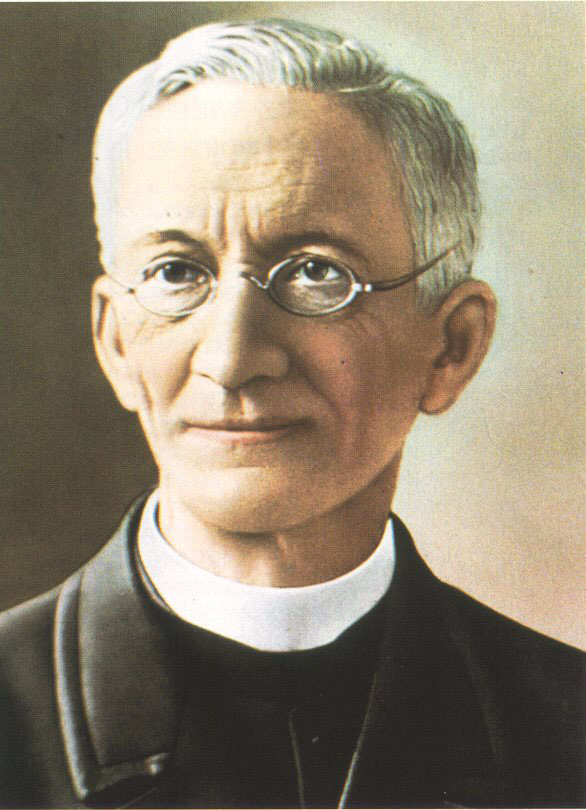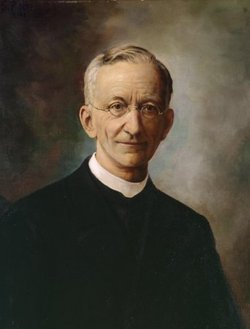
172nd Birth Anniversary of Fr. Leo Dehon

Fr Leo DehonToday, on March 14, the Congregation of the Priests of the Sacred Heart celebrates 172nd Birth Anniversary of its Founder Venerable Fr. Leo Dehon. As usual, on this occasion the General Superior of the Congregation, Most Rev. Fr. José Ornelas Carvalho, scj, addresses all the members of the Congregation and of Dehonian Family with special message. This year, the General Superior reflects on the theme of “Mercy”, in the writings of Fr. Dehon in connection with the theme of the incoming XXIII General Chapter which is “Merciful in Community with the Poor.”

Rome, March 1, 2015

Letter of March 14: the Birthday of Fr. Dehon

A Generative Force for Life

To the members of the Congregation

To the Dehonian Family

Dearest Brothers and Sisters:

Once again, and for the last time, we write you a letter on the occasion of Fr. Dehon’s birthday, March 14. Truthfully, it’s not to recall a date but to remember a man whose approach to God and whose understanding of the  Kingdom of God generated a movement that still is alive today and that draws together many persons into the Dehonian family: women, men, children, young, old, parents, unmarried singles, lay and consecrated people. We wish to cast a glance at Fr. Dehon, a glimpse that always seems to turn up something new for us to consider. It is not possible for it to be otherwise because in each era timely inspiration is given us for obtaining new insights and aspects, hidden from us until this moment, by asking questions that go beyond what we presently know for the sake of joyously making progress, even in our day, in comprehending the gift God has given us in the person of Fr. Dehon.

With this letter we want to share something that seems particularly important to us and on which our reflection is far from finished. This is true as much for us in General Administration as it is for all the members of the Dehonian Family.

“Merciful” – this is the first word in the motto for our upcoming general chapter which will take place from May 17 to June 6, 2015: “Merciful in Community with the Poor”. The General Administration did not come up with this motto; the general chapter preparatory commission came up with it, making use of suggestions which came from the Major Superiors at their meeting in November 2013. Initially, as a general administration, we were greatly astonished by this proposal, particularly by the presence of the term “merciful”. The shock was felt by numerous confreres, not just us. In actual fact, the word “merciful” does not have a particularly significant meaning in Dehonian writings. It does not appear in our Constitutions and our journal, Dehoniana, has never treated this topic. Mercy, therefore, seems not to be an essential element in Dehonian spirituality.

To all of us it seems obvious that the theme of mercy has become ours with greater force thanks to the magisterial teaching of Pope Francis. In fact, from the first day of his pontificate, both by word and action, Pope Francis has proclaimed that the church must be a “Church of Mercy”. By so doing, he has touched many people and has thus responded to the wish of many, both inside and outside the church.

Now, what about us Dehonians?

Fr. Dehon and Mercy

We have set out to ask Fr. Dehon about this topic as if he were present: did mercy represent for him something significant?. If so, what does this word say about God and the Christian vocation in this world? What concretely does he have to say today about the Dehonian vocation in the world?

A first surprise was ours when we researched the site www.dehondocs.it, an extremely useful tool for getting to know our founder because it provides digitalized access to all Fr. Dehon’s writings, which we are in process of publishing. Online research reveals that Fr. Dehon speaks frequently about mercy in his writings.[1] Fr. Dehon expands his understanding of mercy in a far more developed way in his spiritual writing[2] as well his periodical writing. Particularly in his meditations, many chapters have mercy in their titles.[3] Fr. Dehon habitually received his inspiration from bible stories. And we note how frequently Fr. Dehon lived, meditated on and prayed with the bible. And this is one specific quality of Fr. Dehon’s experience for which we are grateful today.

Through biblical narratives Fr. Dehon transmits his spiritual vision to us. His meditations do not contain theological treatises or dogmatic declarations; instead they express the dynamic of his spiritual experience discovered essentially in encounter and relationship. We find ourselves before a God who passionately seeks encounter with man.  In the settings for these stories the following appear: the lost sheep, the coin first lost and then found, the prodigal son, Zacchaeus, Matthew, the Samaritan woman, Peter, Thomas. For Fr. Dehon each one of these figures, in turn, gave witness to the mercy of God and the possibility of new life. God takes the initiative, goes in search of the lost, leaving locales and people well known to him to go out after those who no longer recognize him: “Do you not see how the shepherd goes after the lost sheep? He does not stop at looking, but leaves the others behind, searches wood, swamp, and cliffside. When he finally finds it, he takes it and carries I on his shoulders. In this way, I want to act with you” (RSC 292).

According to the spiritual vision of Fr. Dehon, God not only goes after but welcomes without setting conditions, embraces, forgets the past, all of which makes possible a new beginning beyond any wayward person’s personal expectations and limits. In these stories, we should imagine in our minds all this activity, these encounters, and the joy that results if we truly wish to understand the experience of the kind of merciful God that Dehon proposes.

“Infinite” (infini) is the word that frequently accompanies the word mercy of God in the writings of Fr. Dehon. Infinite and without limits is this mercy, this inconceivable and gratuitous care and concern for the other that surpasses even justice, since “Jesus has the heart of a healer and friend rather than a heart of a stern judge” (CAM 1/242).

This boundless and infinite mercy takes us to the very source of mercy in God that Fr. Dehon frequently describes as an “excess of love” (excès d’amour). For him, this excess of love that appears in mercy has the cross, the passion, and the incarnation as its supreme manifestations. The mercy of love consists in the ineffable act of Christ to empty himself, to become slave while God, as Fr. Dehon says when speaking of the Letter to the Philippians. His vocabulary is somewhat limited theologically in keeping with his times: the words annihilation, humiliation, sacrifice at times speak of a skeptical theological/spiritual way of looking at man rather than of a deeper understanding of the limitless love of God. Nonetheless, what he has to say remains valid when as spiritual master he reminds us of a reality that theology had still to recapture: “There is no other divine attribute of God that Sacred Scripture exalts more greatly than his mercy” (RSC 72).

With the passage of time, theology has come some distance: the mercy of God can be understood only if rooted in Trinitarian theology.[4] The Trinitarian God, Father, Son, Holy Spirit, in itself is communication and relationship. Its essence is immeasurable self-giving (oblation) to the other. In consequence, mercy becomes a mirror of the Trinity.

From this Trinitarian perspective, mercy is from the very beginning of the world the root and reality toward which all else is ordered.[5] Hence, mercy in creation, incarnation, passion, and resurrection is not just a response by God to the sin of the world. It is above all else the regenerating realization and sharing of his being as self-giving toward other.

That mercy was not just a response to the sin of the world but also the essential expression of the Godhead, Fr. Dehon occasionally recognized. In a number of meditations he describes the merciful love of God aimed at men and women, particularly in their sufferings, in their illnesses and states that this excess of love is a regenerative and renewing force, capable of working miracles, healings, and pardon: “Such was the source of his mercy, his miracles, his assistance; a tender compassion which nourished us. Compassion moved him, obligated him to work miracles; he saw those who were ill and his heart was moved with compassion and he healed them. If like the Heart of Jesus we have great compassion for the unfortunate, if we respond promptly according to the merciful desire of the Savior, why could we not be instruments of his Heart in a few graces for healing?” (CAM 1/234).

But how precisely can we succeed in participating in this divine dynamis, in this excess of love that generates new life? The initial response that Fr. Dehon provides is surprisingly simple and transcending his era: trust. In this regard he writes: “This meditation [on trust], the last one in this retreat, is very important and sums up all the others. If a person embraces the practice suggested, he gains all. If he/she does not, the fruit of the retreat will be nullified” (CAM1 256). In this way, Fr. Dehon introduces the last mediation on mercy. Trust in a merciful love: this is the one single condition for entrance into this dynamis.

The second response issuing from Fr. Dehon is this one: “We need to correspond to graces and act on our initiative…practicing mercy toward our neighbor” (RSC 318). Fr. Dehon and the tradition of the spirituality of the Heart of Christ called it “redamatio,” a loving in exchange, even a loving on behalf of those who refuse to love. Mercy asks one to live in an economy/practice of giving.

Surely, there is far more that we must study and apprehend with regard to mercy. We need to deepen and enlarge the matter of the value of mercy with respect to the Dehonian charism.

Merciful in Community with the Poor

At the center of the motto for the next general chapter in May/June 2015, we find community not mercy. It is in the community that we discover our vocation; in it our vocation expresses itself for the first time; from our community we are sent toward the various forms of apostolate.

The centrality of the community in the motto is accompanied by a preferential quality which is that of mercy and by a preferential place of service which is that of the poor.

Is mercy a quality that renders our communities distinctive? The question refers to Dehonian communities as well as to the numerous groups that are inspired by the Dehonian charism. The question refers, first of all, to the reality and witness of our living together insofar as we are Dehonians? Is there really an excess of love that is realized in our giving ourselves to each other? Does our service, our oblation (self-giving), our availability, our reconciliation begin only after leaving our religious house or apartment? If we take seriously what we understand about mercy according to our tradition, our very living together becomes a proclamation of a merciful love which makes a new quality of life possible beyond barriers of culture, nationality, character, sin.

And then, after an experience of the mercy of God, we are necessarily led toward the poor.

Mercy is not sugary or unseasoned and naive. Someone who experiences the merciful love of God cannot not be an instrument of this love, particularly in areas where life is threatened, repressed, limited, or wounded. The fact that 100 years ago, Fr. Dehon involved himself – despite the cautions from some brethren – on behalf of a social dimension to our congregation was not the result of a political calculus or sense of moral obligation. It was a response. This response was to that love that was revealed on the cross as the source of life and victory over every death.

With profound joy and most respectfully we see how men and women within the Dehonian Family continually draw their inspiration and are moved by mercy, ready to reach out to the edges of society, as Pope Francis recommends. In an era like our own, burdened with unimaginable violence, who could doubt that the world needs mercy, or, using Dehonian language, the Reign of the Heart of Jesus?

At the beginning of this letter we simply wrote that we wished to share with you what is slowly coming to the fore: a new aspect in the spiritual experience that characterized Fr. Dehon’s words and actions; a matter of enrichment for our Dehonian vocation while we gratefully keep in mind Fr. Dehon’s birthday.

One Last Time

This is the last letter that this general administration, elected in 2009 to lead the congregation, will address to you. In these past six years, we were called to be custodians of the heritage that Fr. Dehon left us. It has been a privilege for us during this period to open up the treasure of Fr. Dehon’s writings to a world-wide public by online publication. The 22nd chapter asked us to pay attention to the centrality of the person of Christ in the life of the congregation. Christ is the gift we have received, the likeness of God that emptied himself (Phil 2:8), and who shared our life and revealed his immense capacity for love through his opened side.

We ask you to pray for the congregation, particularly during the general chapter itself. Chapters are special times in the congregation. It is a sign of what we know happens at our better moments, moments during which we believe that the Spirit of Jesus is more active within us. It is a time to look at our past as well as to look at the future, toward a time during which our words will pave the road that we shall have to walk over the next six years. Rally your communities and pray for us from May 17 to June 6.

March 14 is also the day of prayer for vocations. Let us pray for those people who will shortly be part of the Dehonian Family. We ask the Lord that their lives be enriched by faith in the love God has for them. We ask that the Dehonian charism will always be a call for others to follow. Let us believe that what Fr. Dehon contemplated in the pierced side and at the center of the Bible, the gift of mercy, be what gives life not only to our “souls” but also to the societies in which we live.

To the entire Dehonian Family we extend a joyous remembrance of Fr. Dehon’s birthday.

In Corde Jesu

Fr. José Ornelas Carvalho, scj

Superior General

and his Council

[1] The lemma “mercy” appears in dehondocs 808 times. From a frequency aspect it appears far less than “love” (3980x), “sin” (1951x); yet it is more frequent than the words “immolation” (405x) and “oblation” (185x). Accessed Feb. 03, 2015.

[2] Les Couronnes d’Amour (CAM), La Retraite du Sacré-Coeur (RSC), L’année avec le Sacré-Coeur (ASC).

[3] “The Heart of Jesus is All Love and Mercy” (CAM 1). “Mercy of the Heart of Jesus for Sinners” (CAM 1). “The Mercy of Our Lord Invites us to Return to His Love” (RSC). “On the Mercy of God” (RSC). “Conversion of St. Peter through the Profound Mercy of the Heart of Jesus” (RSC). “Heart of Jesus, Patient and Very Merciful” (MSC).

[4] Walter Kasper, Mercy-The Essence of the Gospel and the Key to Christian Life. NY: Paulist Press. 2014. Especially V, 2: Mercy as Mirror of the Trinity.

[5] Walter Kasper, Mercy, pp 150ff.

PHILIPPINES – INDONESIA DEHONIAN FAMILY MEETING

Last January 31 to February 1, 2015, delegates from Indonesia came to the Philippines for a meeting to discuss the implementation of the Spiritual Path (Iter Formativo). The encounter took place in the Sacred Heart Formation House, Cagayan de Oro City.  With the blessing and support of Fr Andreas Madya and Fr Franciszek Pupkowski, respective Superiors of the Indonesian Province and Philippine Region, the group gathered to make a strategic plan of action regarding the development of the Dehonian Family in the Asian continent.  Grace Escobia, who is a member of the interim International Coordinating Group of the Dehonian Family whose area of responsibility is Asia, coordinated the encounter.

The gathering was participated by Fr. Agustinus Setyoaji, Fr. Anselmus Inharjanto, Fr. Aloysius Yudhistiro and Mr. Philippus Harijadi from Indonesia and Marian Cabarliza, Lovely Monique Nanol, Joan Palapar and Fr. Richie Gier from the Philippines.

The meeting started with the input about the Charter of Communion of the Dehonian Family.  This was followed by the sharing of the message regarding the international encounter in May 2014 in Rome.  Afterwards there was a presentation from the respective countries of the state of affairs in their distinct realities about the situation of the Dehonian Family, specifically, the laity and youth group. It was observed that both countries thus far have an active youth group while the laity is still a work in progress.  The presence of consecrated persons in Indonesia, specifically, the Compania Missionaria, was recognized and integrated in the planning.  Each entity of the Dehonian family was essentially encompassed including the Dehonian Youth.

In the morning of February 1, 2015, brainstorming and discussion ensued about the integral plan of action for the development of the laity and consecrated persons in the Asian continent vis-à-vis the implementation of the Iter Formativo in the context of the program outlined by the International Coordinating Group for 2015 to 2017.  The participants were able to devise a plan within the given period for the growth of the Dehonian Family in Indonesia and the Philippines. It was also decided, in the perspective of Sint Unum, to invite delegates from India and Vietnam as observers in the next continental coordinating group meeting for Asia tentatively scheduled in January 2016.

The encounter was concluded by a Eucharistic Celebration concelebrated by the Indonesian Dehonian fathers headed by Fr. Agustinus Setyoaji. A number of Lay Dehonians from Cagayan de Oro joined the mass.  The group was enriched by the beautiful sharing of experiences on how the Dehonian Spirituality is lived out in the respective countries, the exchange of ideas and resources for development and formation, as well as looking forward to another encounter in 2016 which is planned to be held in Vietnam.

What was most striking was the teaching on LoReSa as imparted by the Indonesian fathers… love, readiness and sacrifice. The witnessing of Ecce venio and Ecce ancilla. Indeed, as Dehonians we are called to love, to readiness (availability) and to sacrifice – that the Kingdom of the Heart of Christ may reign. Adveniat regnum tuum.

By: Atty Grace Escobia

Sharing of Experiences

Fr. John Czyzynski, SCJ, a retired Novice Master from the U.S, Province is on his visit in the Philippines. The main purpose of his visit is to share his experience as a formator with the formators of the Philippine Region. The majority of the formators in the Philippines are young and lack of experience, but on the other hand very much willing to learn from their older brother.

The meeting with Fr. John took place in Cagayan de Oro City at the Sacred Heart Formation House from January 19 – 21, 2015 and was attended by eight formators representing all the stages of formation. Besides the sharing of personal experiences on both sides, there were many practical questions on how to do the formation in the time of constant changes in the world,and of mentality, how to deal with the issues of proper use of the internet, social networks, etc., that sometimes disturb the formation process.

The meeting was very much appreciated by the formators and gave them many insights that can be helpful in their work. Sometimes life experience is more valuable than series of lectures.

Letter for the Birth Anniversary of Fr. Dehon

dehon3

Letter of March 14: the Birthday of Fr. Dehon

Dear Confreres,

March 14 is a day on which we remember not only the birth of our founder, Léon Dehon, but also the birth of our vocation. In doing so, we pray that this vocation will live on in others, and are reminded to help others –– from all walks of life, in the many places we serve –– to find the vocation that is alive within them.

For us, March 14 is our vocation day.

For many visitors to Rome, part of their pilgrimage includes a stop at the church of San Luigi dei Francesi. It is known for the three paintings of Caravaggio. In his interview with Antonio Spadaro, Pope Francis made a reference to the most famous of the three paintings: The Calling of Saint Matthew. For those who do not know the painting, Matthew and his helpers are sitting at the publican’s table counting money. In the doorway stands Peter and Jesus. Behind them is a light that falls upon Matthew and upon what he is doing. Matthew’s gaze, as well as of two youngsters sitting at the table with him, is fixed in the direction of Jesus. Jesus points with his finger in the direction of Matthew and Matthew in unbelief points his own finger to his breast with the obvious question: “Who? Me?” Matthew is drawn into the light. It was his future.

It is sometimes said that callings are intrusive, even violent. None of this is evident in the painting. Jesus points at Matthew, but looking at the pointing hand one sees the index finger not straight and imperious but curved downwards, much like the finger of the Creator in Michelangelo’s creation of Adam in the Sistine Chapel. The finger questions Matthew. Matthew is presented with an enigma, which is clearly shown on his face. “Yes, even you Matthew, with a table of grubby tax money before you. Yes, you! Come, follow me.” The Gospel text tells of no hesitation: “And he got up and followed him.” (Mt. 9.9)

We, who have experienced it, know the feeling of the calling. The notion of vocation or call has not only generated interest among religious but also among philosophers. There is a rather wide body of literature that has studied the phenomenology of the call: what happens when someone is “called.” These reflections go to the core of what in human existence occurs when confronted with the call. There is no clear voice – nothing that that indicates a caller. The caller remains anonymous, indefinable. I do not control it. It does not come from me. It comes from elsewhere – perhaps, in something beautiful – and I know it to be important because it feels life-determining. The Jewish philosopher Levinas called it “a provocation from God[1].” It provokes me to give a certain direction to my life.

As with the call of Jesus to his disciples, a call impels one to leave one’s “home”, to get off the couch. The French philosopher Jean-Louis Chrétien says that to be called is to be “required.” There is a certain urgency attached to a call, a feeling “required” to take a certain direction in life. In following the early life of Léon Dehon, one reads frequently about the disturbance caused by his vocation: “I am forever preoccupied with my religious vocation…” he wrote in 1875 (NHV XI,152); he spoke of what he perceived of “the way God guides me in life » (NQ XLIV 30), of his “suffering”  (NHV XI,177).  Most of us have followed this internal urge, listened to its impulse and sought to follow where it led us. Our vocation became our mission. The call also made us go in search of the One who called us, to befriend the origin from which the call came. That has been our life.

On March 14th we recall this search and its resolution. We need to bring ourselves back from time to time to our own experience of the vocational call. What happened to me? What did it require of me? Where has it taken me? For Dehon his call was clear from age twelve onward. He never doubted it. We may not have experienced it in a straight way – perhaps only a constantly-returning appeal to be true. On March 14th let us celebrate it. Fr. Dehon described it as a faith journey with God’s love.

The day also invites us to speak to others about their call; how has it been experienced in the lives of others? A call is very individual, but also a shared experience. We might understand and appreciate our own call better by sharing it with others, and hearing their stories.

In 1914 at table Fr. Dehon asked a young person why he wanted to become a priest. He told the founder “St. John was the apostle who loved, then love the Lord – that is the basis of a vocation.” (Position II, 408) Love is a good place to start. For Dehon, without it we could do nothing.  And so let us take it up in our prayers when we talk with the one who first impelled us. It is probably the most important appeal or invitation made in my life.

In Corde Jesu

Fr. José Ornelas Carvalho, scj

Superior General


[1] Isabelle Thomas-Fogiel, The call in the thought of Lévinas, Marion and Chrétien,  Aisthesis – Rivista Online di Estetica, 2/2011

General Superior: Christmas Letter 2013

navidad (1)

Christmas Letter 2013

Jesus Christ is born in each of our separate realities

Christmas returns; returns with its light, returns announced by many little signs that are designed to enrich our provinces, regions, and entities. Returns to give direction, to astonish and to help us to be open to hope.

Jesus Christ was born bringing joy, present with the universal church during its important moments. Pope Benedict XVI stepped down in a gesture of profound humility. This path has been continued by Pope Francis. The two popes, in different ways, have told us that without a constant relationship with God our mission becomes just a job. The risk of activism, of trusting too much in structures, is always lurking. The more that the mission calls us to go to the outer reaches of our existence the more the heart must be united to that of Christ, full of mercy and love. It is here that Jesus Christ is born.

He was born in the many, even historical, meetings we shared this year. From January 10-15, 19 Dehonian bishops met with the general administration of the congregation to reflect on how to live the Dehonian charism in episcopal ministry, and how the congregation can collaborate with the local church.

On April 8, the Solemnity of the Annunciation of the Lord, we began a meeting of the directors of our SCJ scholasticates.  This ran through April 13 at the General Curia in Rome. The meeting had multiple objectives: to study the new Ratio formationis Generalis; to identify commonalities in our initial formation programs: spirituality, charism, internationality, training in economic and social engagement; and moreover, to build a spirit of fraternity and collaboration among our formators in view of international collaboration in our scholasticates.

From June 17-20 the General Curia hosted the secretaries of our various entities. We stressed the fact that the secretaries are an important instrument in the service of mission and communion of the congregation. Our work is built around the important role secretaries have in the preparation of agendas for council meetings, and in regards to assemblies and chapters, not as a technical service, but as an expression of spirituality and mission which is expressed in the “Sint Unum” dear to the founder. The “Secretaries Handbook” was presented at the meeting, which is an invaluable tool for the secretaries’ work.

In Rio de Janeiro in June the World Youth Days brought together a great number of youth. In the days previous to the event our community in Brazil hosted many young people coming from our entities who came to be strengthened in the Dehonian spirit

In September we began the formators’ course. There are 14 confreres from 11 entities deepening their understanding of our spirituality in order to help young people discover and discern God’s call in their own lives.

To continue to give birth to Jesus Christ and His Kingdom, from November 3-9 we had the meeting of the major superiors. The work of the gathering focused on developing guidelines for the preparation of the XXIII General Chapter that will be held from May 16 to June 6, 2015. The introduction to our work reminded us of the need for creativity, to be prophets that discern, poets that sing the word, and laborers building a new reality. In the first days of this month of December, from the 6th to the 8th, the Preparatory Committee of the XXIII General Chapter met in Rome. During this first gathering they set forward the path that the Congregation will walk in preparation of the Chapter, which will be convoked at the end of the year.

Christ was born when we faced challenges at the continental level. This year Africa held its Continental Conference. It strengthened the sense of belonging and gave new impetus to the desire to enhance the Dehonian presence through shared meetings and collaboration, sharing formational expertise at the entity level, finding concrete paths toward collaboration.

The leap to North America was not small, and concerns there are equally important. In particular, we focused on lifestyle issues, especially in regards to how we live the vow of poverty in the context of North America. How do we give value to religious life in that context, renew community life and provide opportunities for sharing with each other and welcoming confreres from other entities?

The Continental Conference in Latin America helped to raise awareness and sensitivity toward the various projects of the continent and discuss how to implement them in new ways. We reflected openly, identifying challenges, both in society and in the congregation. In addition, we discussed possibilities for promoting collaboration between the entities in structure, formation and mission.

Jesus Christ was born when we were thankful, remembering years of service and commitment because his kingdom comes. Remembrance for those who have experienced a piece of these stories is not without meaning, engaging the full attention and interest of mind and heart. The Province of Cameroon (CMR) celebrated 100 years of the Dehonian presence. The District of Austria-Croatia (ACR) recalled 100 years of SCJ presence in Vienna. South America celebrated 120 years of presence and 50 years as a Province in Brazil-Recife (BRE) and the 30th anniversary of the establishment of the province of Argentina (ARG) with its dependent District of Uruguay (URU).

The list of thanks extends to our newest initiatives. On August 12, Vietnam (VIE) was established as a district; September 21, Ecuador (ECU) took on the configuration of a district. These are entities that are young and full of fresh, new energy for the future of the congregation.

Jesus Christ was born in new vocations. In the past year there were 41 novices, 52 first professions and 22 new priests. For all these we say our thanks to the Lord of history who never stops thinking about the good of his kingdom.

A fresh breeze has come to many of our entities through new administrations. The entire congregation gives thanks for the service that so many brothers carry out for many. Chile (CHI) and Madagascar (MAD) welcomed new administrations on January 1, 2013; Poland (POL) has had a new council since January 15; January 18 was the start of the new administration in Venezuela (VEN); in the summer, on July 15, we had new administrations in Indonesia (INA), in the Provinces of the United States (USA) and Germany (GER) on August 1. Vietnam (VIE) and Uruguay (URU) began new administrations on August 12, South Africa (RSA) on August 30, and Argentina (ARG) on November 1.

Jesus Christ was born amidst the unexpected. On February 1, the German Province realized, after almost 20 years, the dream of returning to Berlin. A few years ago the return to Berlin was not even imaginable, a trek into the heart of the most de-Christianized part of Germany. Also in Toronto, Canada, the presence of SCJs from other entities gave new visibility to internationality but also to a new life through mutual collaboration. In the meantime, the first steps were made to build an international community in London.

On May 6 the Holy See announced the appointment of Fr. Zolile Peter Mpambani as bishop of the small Diocese of Kokstad, near Durban, South Africa. It is a good sign for the Dehonian presence in that part of the world, an invitation to be in communion with the universal Church.

Solidarity has never been lacking in our congregation, but it becomes even more evident during extraordinary events where we see how the sense of justice and love for others becomes concrete. The typhoon in the Philippines developed a chain of solidarity in such a way that brings honor to our congregation, and says how great it is to work for the kingdom of God.

Christ Jesus was met by our 34 brothers who died this year. We entrust them all to his mercy and join in this remembrance Cardinal Stanislaw Nagy, SCJ, cardinal-deacon of Santa Maria della Scala. In the telegram of condolence to Cardinal Stanislaw Dziwisz, Archbishop of Krakow (Poland), Pope Francis recalled “with gratitude his fruitful collaboration, mutual respect and cordial friendship with Blessed John Paul II, as well as his intense ecumenical activity.”

During this time we reflect on the Lord who is born in all of these realities, and we affirm the true meaning of Christmas. We do not look at these events in isolation but with the language of our spirituality and the Good News that affects all of humanity. The birth of Jesus is the link, the embrace of justice and truth, a fruitful encounter between heaven and earth, filled with hope and the promise of peace and a full life.

We wish each one of you a Blessed Christmas and a New Year 2014 filled with blessings, trusting that the Spirit of the Lord will assist us in the Chapters of the different entities in preparation of the XXIII General Chapter in 2015.

Fr. José Ornelas Carvalho

Superior general

and his Counci