
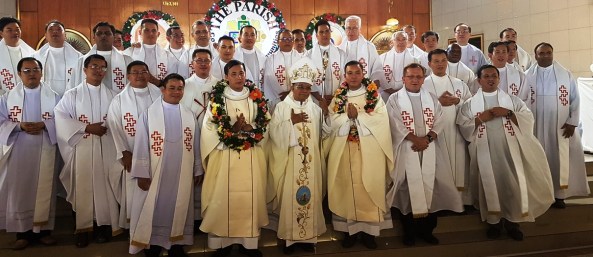
 On January 8, 2017, on the Feast of Epiphany, which in the Philippines is celebrated on Sunday after January 6, two SCJs from Vietnam: Dn Dang Van Nguyen and Dn Luong Van Nguyen were ordained priests. The ceremony of ordination, as in most cases, took place in the San Lorenzo Ruiz Parish in Tierra Verde Homes I Subdivision in Quezon City, a walking distance from the Dehon House, which at the present is under the pastoral care of three SCJ priests.


The ceremony of ordination headed by the Bishop of Novaliches, Most Rev. Antonio R. Tobias, DD, was held during the main Sunday Mass at 10:00 am, and it was attended by many SCJ confreres from Vietnam and the Philippines, priests and religious from different congregations, family members and friends.


Fr. Dang is 33 years old and comes from the Diocese of Thai Binh, while Fr. Luong is 37 years old and comes from the Diocese of Bui Chu. Both of them arrived in the Philippines on September 30, 2007, where they underwent the process of initial formation and completed their studies. Prior to this, both of them were active in the Church; Fr. Dang was the organist for the children’s choir and Fr. Luong was the leader of altar servers. Fr. Luong wanted to become a diocesan priest, but due to some circumstances he was not able to fulfill his plans. Instead of entering the seminary he went to Saigon to continue his studies. In Saigon he met Fr. Jerry Sheehy, SCJ, who invited him to join the Congregation of the Priests of the Sacred Heart of Jesus. Fr. Dang’s vocation to the priesthood was born when he was still in the grade 6. As he relates “I felt that I am a sinful person and I should become a priest to repair it.” In Saigon where he studied and taught catechesis in a Dominican Parish, he met also Fr. Jerry, who deeply impressed him and helped him to enter the seminary.
Wishing to the newly ordained priests all the best, especially perseverance in their vocation and serving the people, we offer a prayer for them as we expect them to pray for us too.
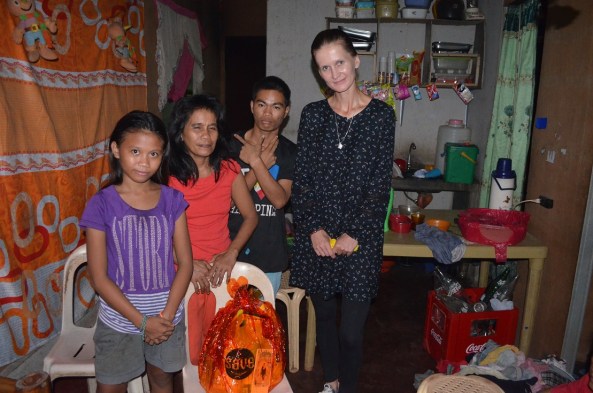 Miss Karolina Mankiewicz is a lay missionary from Poland who arrived in the Philippines in October 2016. Prior to this she was working as a teacher in grade school and was very active in the campaign organized by a Polish SCJ, Fr. Piotr Chmielecki, called “Zbieram to”, which means “I collect it.” Together with other volunteers, she collected used batteries and cellphones, old appliances, and many other things for recycling. The purpose of this action is double: to save the environment and help the missions. The money obtained from this are used to help the poor and needy in different countries where the SCJ missionaries are working. Among many beneficiaries of this action is also the Philippines, particularly the victims of typhoon “Sendong” (Washi) living in “Mother of Divine Mercy Village” in Opol, Kasanag Daughters Foundation, and others.


 On November 11, 2016, Fr. Patro Gier, SCJ, will leave for his new assignment in Finland. The main purpose of his joining the SCJ Finnish District will be taking pastoral care of the numerous Filipino people living in Finland. He will follow in the footsteps of Fr. Jigger Ganados, SCJ, the first SCJ Filipino missionary to Finland who went there in December 2014.


 This year the SCJ Philippine Region was entrusted with three new pastoral areas. Because of this several SCJs for the first time became parish priests. Although they were assigned in the parishes and have some pastoral experience many things for them are new. Being an assistant to the parish priest is like sitting in the front seat, but not being a driver. According to the Canon Law “The Parish Priest is the proper pastor of the parish entrusted to him… exercising the pastoral care of the community entrusted under the authority of the diocesan Bishop, whose ministry of Christ he is called to share…” (Can. 519). The role of a Parish Priest is twofold: as an administrator and as a shepherd, who acts in the name of the local bishop and is accountable to.


