51st International Eucharistic Congress – Theological Symposium

IECMore than 1,500 participants attend the 3-day International Eucharistic Congress (IEC) Theological Symposium at the Cebu Doctors’ University (CDU) which started on January 20 and will end on January 22, 2016.

The Theological Symposium is serving as an underpinning for the 51st International Eucharistic Congress that will be held from January 24 – January 31, 2016, in Cebu. The theme of the IEC 2016 is “Christ in You, Our Hope of Glory.” (Col. 1:27). The 33rd IEC on 1937 was held in Manila, the first for the country and has returned only in the Philippine shores after 79 years.

Among the topics to be taken up are the Christian virtue of hope, an exegetical discussion of a passage from the gospel of St. John, liturgy and inculturation, the history of the “Novus Ordo”, the evangelization of the secular world, and a catechesis on the Sunday Eucharist.

The topics have been chosen for their relevance to the theme of the IEC which is three-fold: the centrality of the Eucharist in Christian life, the liturgical celebration and the social dimension of the Eucharist.

It is hoped that the symposium would give clear ideas to those who are not yet familiar with the theological understanding of the sacrament, or otherwise would offer a review if not deepen the knowledge of those who already have studied and are availing of it.

The symposium would also give a glimpse of the current issues, problems and challenges regarding this sacrament in the different places and cultures of the world.

Workshops will also be held to come up with pastoral plans, strategies and programs.

Day 1 – January 20, 2016

Day 2 – January 21, 2016


Day 3 – January 22, 2016


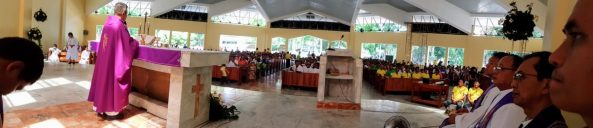
Here is the homily for the Concluding Mass for Day 3 of the ‪#‎IEC2016‬ Theological Symposium by Archbishop Antonio Ledesma, SJ, DD.

Sinulog Festival and Santo Niño Devotion in the Philippines

sinulog2016-1

“Viva Pit Señor!” That’s what the people of Cebu City, Philippines, chant throughout the Sinulog Festival, held every third Sunday of January. It is the month when one of the grandest and most colorful festivals of the Philippines is celebrated. The Sinulog Festival is celebrated in honor of the Santo Niño, the Child Jesus, the Patron of Cebu and the Philippines and reminisces the time when Filipinos embraced Christianity in the 16th century. The word ‘Sinulog’ is from the Cebuano language adverb ‘sulog’. It means “the rippling of water or water current movement.” Its adaptation describes the forward-backward step movement of the Sinulog dance, performed by many during the Festival.

The actual historic event, which the Sinulog Festival commemorates, occurred on 7 April 1521, when Fernando de Magallanes, a Portuguese navigator, landed on Cebu Island in the central Philippines and claimed the area in the name of the King of Spain. Until this date the Philippines practiced indigenous, Asian, and Islamic religions.  Magellan gave the Santo Niño wooden statue to Rajah Humabon’s wife, Hara Amihan, as a baptismal present. Rajah Humabon was Cebu’s ruler at that time. In honor of Carlos the First’s mother, Juana, Hara Amihan’s name was changed to Queen Juana. 800 natives together with their rulers were baptized into Christianity. Unfortunately, shortly after the conversion, Magellan went into reckless adventure by fighting the reigning ruler of Mactan Island, Rajah Lapulapu, with only a handful of men. He was killed in the encounter on 27 April 1521.

The remaining members of Magellan’s expedition returned to Spain to report the incident and the possibilities for conquest. It took 44 years before a new group came and began the conquest and formal Christianization of the islands. Miguel Lopez de Legaspi arrived in Cebu on 28 April 1565. His ships bombarded the native villages and inside one of the burning huts, a soldier named Juan Camus found a wooden box containing the Santo Niño statue.

Historians say that during the 44 years between the coming of Magellan and Legaspi, the natives continued to dance the Sinulog. This time however, they danced it no longer to worship their native idols but as a sign of reverence to the Santo Niño.  The original intact Santo Niño statue is now enshrined at the San Agustin Church (renamed Basilica Minore del Santo Niño) in Cebu City.

The Sinulog originated with the original candle vendors who sell their wares in front of the Augustinian Church of Cebu. They were the first, a couple of hundred years ago, to do the forward-and-backward movement of the prayer-dance of petition and thanksgiving to the Santo Niño. The movement is said to imitate the sulog (flow) of Cebu City’s Pahina River. While dancing–waving their lighted candles–the women chant “Pit Señor! Pit Señor!” Many, even Cebuanos, don’t know what the chant means until told that “pit” is the abbreviation of the word sangpit – which is Cebuano for “to call the name of” and therefore “Pit Señor” means say “Hail, Lord!”

The participants in the Sinulog Festival wear bright-colored costumes and dance to the music made by trumpets, native gongs, and drums. The streets are full of people eager to witness the beauty of the festival and to pay homage to the Santo Niño. The Santo Niño Sinulog Festivals are also held in other parts of the Philippines and in other countries around the world.

sinulog 2016Traditionally, the Sinulog Festival is celebrated for nine days. The ninth day culminates in the Sinulog Festival Grand Parade. A reenactment of the Christianizing of Cebu follows at the Basilica. A solemn procession is held in the afternoon along the city’s major streets. This usually lasts for hours due to multitudes of participants. A Pontifical Mass headed by the Cardinal is held at the Basilica. Bishops of Cebu assist in this event. Devotees and others populate the Basilica to attend the mass. Afterward, they all head out to the streets to witness the Sinulog Festival Grand Parade.

This is the event around which the Sinulog Festival revolves. The main theme of the Sinulog dance is Queen Juana, with the Santo Niño in her arms, blessing the people that are ill, poor, etc, and needing the healing of Santo Niño.

The Santo Niño Devotion is an important part of Filipino religious life and the Sinulog Festival is a time for joyful and colorful celebration. For a spectator on the street, it’s a beautiful scene to behold. But for participants doing street dancing, it’s a way to show their devotion to God. The Santo Niño Devotion is not a form of idolatry. The Child Jesus is one manifestation of Jesus, the Son of God, who died for us on the Cross, to save us and to offer us Eternal Life.   Other forms of Devotion to Jesus Christ include the Sacred Heart, Devine Mercy, Holy Name, and Eucharistic Adoration.

“Thank you” from Tanauan, Leyte

Tanauan is one of the oldest towns in the Province of Leyte, Philippines dating back to the year 1710. It is a second class municipality composed of fifty-four (54) barangays. According to the 2010 census, it has a population of 50,119 people. The town has been baptized the title of “Cradle of the Intellectuals” or “Bungto Han Kamag-araman” since the Spanish colonial period. Tanauan is approximately eighteen (18) kilometers south of Tacloban City which is the Capital of the Eastern Visayas Region. It is bounded on the north by the Municipality of Palo, on the south by the Municipality of Tolosa, on the west by the Municipalities of Dagami and Tabon-Tabon, and on the east by San Pedro Bay. The town was heavily damaged by Super Typhoon Haiyan (Yolanda) in November 2013. (From Wikipedia)

Recently, the Priests of the Sacred Heart in the Philippines, who helped the victims of Typhoon Yolanda in Tanauwan, received a plaque of “Thank you” from the Local Government of the said town. The group of seminarians from Dehon House in Quezon City, under the guidance of Fr. Delio Ruiz, SCJ, spent their Christmas break extending their help to those who lost everything they had, including members of their families. Here the SCJ Philippine Region would like to thank all those, who through their generosity and open hearts made it possible.

Priestly Ordination of Deacon Dinh

D20A0416On November 30, 2015, Feast of Saint Andrew, the Apostle, Deacon Dinh Van Nguyen, member of the SCJ District in Vietnam, was ordained a priest. The ceremony of ordination took place during the Holy Mass at  in Tierra Verde Homes I Subdivision, Barangay Pasong Tamo in Quezon City, presided by the ordaining bishop, Most Rev. Antonio R. Tobias, D.D., the ordinary of the Diocese of Novaliches, where the parish and the SCJ Formation House belong.

Fr. Dinh is 39 years old and comes from the family of seven children in Dong Nai Province in Vietnam. He has two sisters and four brothers. In 2002, he arrived in the Philippines to study Philosophy at the Xavier University in Cagayan de Oro City, where he met the first SCJ students from Vietnam. Although his initial wish was to become a Jesuit, he got easily attracted to the spirituality of the Priests of the Sacred Heart and decided to be one of them.

His vocation to the priesthood started 21 years ago when he was an altar boy. He got attracted by his parish priest who was very simple and holy. His wish that time was to become one day like him, and now his dreams came true.

Fr. Dinh is the 8th SCJ, who underwent the formation process and was ordained in the Philippines. His plan after the ordination is to return to Vietnam, to work in the formation program and to teach Philosophy or Theology.

D20A0422

The ordination of Fr. Dinh was attended by more than 30 family members and friends from Vietnam and many friends from the Philippines.

Congratulations Fr. Dinh and God bless you on this new way of life from all the members of the SCJ Philippine Region!

+ Bp. Federico O. Escaler, S.J., D.D.

Bp. Federico EscalerYesterday, on November 28, 2015, the former and the first Bishop of Prelature of Ipil, Most Rev. Federico O. Escaler, S.J., D.D., at the age of 93, has joined the Lord. Bp. Escaler was one of the two bishops who in 1989 accepted members of the first group of SCJs into his Prelature, entrusting them two parishes: Margosatubig (now Diocese of Pagadian) and Kumalarang (Diocese of Ipil).

All members of the SCJ Philippine Region express their gratitude for Bp. Freddy’s fatherly care and love and join the prayers in his intention. May he rest in Peace!


Biography of Bishop Federico O. Escaler, S.J., D.D. (1922-2015)
By Sch. Amado T. Tumbali, Jr., SJ
Asst. Province Archivist

The Most Reverend Federico Ocampo Escaler was born on 28 June 1922 in Manila. On his birthday in 1941, after finishing a degree in Ateneo de Manila, where he also studied his primary and secondary education, Freddy, as he had been called in the Society of Jesus, entered the Jesuits at Sacred Heart Novitiate, Novaliches. However, Freddy and his fellow novices moved to Ateneo de Manila at Padre Faura during the outbreak of WWII. They began Juniorate there on 1 June 1943 but eventually moved to La Ignaciana in Sta. Ana, and then, finally back to Novaliches. From 1945-1948, he studied and finished his M.A. in Philosophy at St. Robert Bellarmine College which was first located in La Ignaciana, and then in Novaliches. He was a regent from 1948-1951 at San Jose Seminary in La Ignaciana where he taught English, Latin, Tagalog, Spanish, Sociology, Philippine Government, and Geometry. He was also the Prefect of Discipline to the major seminarians and moderator of the Sodality, the choir, and INSTA. He studied and finished S.T.B. and S.T.L. at Woodstock College, Maryland, U.S.A. from 1951-1955. He was ordained deacon at Fordham, New York, U.S.A on 18 June 1954 by Bishop Thomas J. Feeney, S.J., D.D. and priest the following day by Francis Cardinal Spellman. From 1954-55, he did some special studies in Guidance and Counseling at Boston College and Fordham University, respectively.

After Fr. Freddy’s tertianship at Palacio del Santo Duque, Gandia, Valencia, Spain in 1956, his first assignment as a priest in the Philippines was Minister at San Jose Seminary in Highway 54. A year after, he was assigned Archivist of the Vice Province and Socius to Vice Provincial Francis Clark. In 1961, he became Superior and Minister of La Ignaciana Retreat House in Sta. Ana. While serving those competencies, he also gave retreats around the country.

In 1962, Fr. Freddy was Rector and President, while teaching Theology, at Ateneo de Davao. In 1966, he was back to Xavier House as Province Treasurer. While in Manila, he was also Chaplain of the Christian Family Movement. In 1973, he was assigned to Ateneo de Cagayan (X.U.) as Rector and President, while teaching Theology. Three years after, he was named as the first Bishop of then to be established Prelature of Kidapawan in North Cotabato. In 1976, he was ordained bishop on the feast of St. Ignatius of Loyola by Jaime Cardinal Sin at Manila Cathedral. From 1976-1980, he was in Kidapawan until his assignment to pioneer the newly created Prelature of Ipil in Zamboanga Sibugay, where he dedicated himself for 17 years until his retirement on his birthday in 1997. Those indeed were tough years, including his first episcopal assignment. “Ipil and Kidapawan were hotbeds of conflict during the time,” as writer Christian Dy describes. Indeed, in 1985, Bishop Freddy was kidnapped and in 1995, another group of armed militants torched Ipil and left at least 53 dead.

Back in Manila, he continued pastoral work as Spiritual Director of Buklod ng Pag-ibig, Chaplain of A.I.M. and the Cenacle Prayer Group. Towards the end of 2015, a mass was discovered in his liver for which he declined further intervention. He died on 28 November 2015 in his family ancestral residence in San Miguel, Manila.

(http://www.phjesuits.org/portal/bishop-federico-o-escaler-s-j-d-d-1922-2015/)