On December 8, 2018, the Immaculate Conception Parish in Aluba, Cagayan de Oro City, celebrated its Patronal Feast of Immaculate Conception. The concelebrated Mass was presided by Fr. Bon Genson, SSJV, first diocesan priest who comes from this parish.
At the end of the Holy Eucharist, the parishioners renewed their Act of Dedication to the Blessed Virgin Mary, followed by floral offering and common meal.
The Immaculate Conception Parish in Aluba is being administered by the Priests of the Sacred Heart of Jesus (SCJs) since June 1, 2011. At present Fr. Janusz Burzawa is the Parish Priest and is assisted by a deacon Rev. Ruel C. Paalisbo,SCJ.
The new general administration, together with the community of the general house in Rome, and other Dehonians who were present, met the Holy Father, Pope Francis, during the general audience on Wednesday, November 28, 2018, at the Paul VI Audience Hall.
There was a desire to have an audience with the pope during the General Chapter, which was in July. However, Pope Francis was not available. It was hoped that a meeting could take place at a later date.
On Wednesday, the pope concluded with a reflection on the commandments: “In the contemplation of life described in the commandments, that is a grateful, free, authentic, blessed, mature, guardian and lover of life, faithful, generous and sincere, we, often without realizing it, find ourselves before Christ. The Decalogue is his ‘x-ray’, which he described as a photographic negative that lets his face appear –– as in the Holy Shroud.
“And so, the Holy Spirit nurtures our heart by putting in it the desires that are His gift, the desires of the Spirit, the desire according to the Spirit, and his rhythm, the desire with the music of the Spirit.”
We were also involved by that silent child who took the liberty of going to the pope and then to the Swiss Guard: “This child cannot speak, he is silent, but knows how to communicate,” said the pope. “He is free, unruly free, but free! Am I so free before Jesus?”
At the end of the catechesis, after greeting the sick and the newlyweds, the Pope came to meet us, arranged on the steps, to take a group photo with him.
Looking at Fr. General, the pope greeted us with a joke: “Is this the new superior general or the next bishop?!” recalling what happened in April.
We smiled because we knew what he meant!
Immediately Pope Francis added in Italian, and then repeated in Spanish: “Pray for me!”
We left him to continue his greeting of the pilgrims, bringing with us the invitation, repeated, to pray for him. This is what we do and will continue to do!
The community of the General House is pleased and grateful to have had a meeting with the successor of Peter, as he loved Fr. Dehon.
This was really a “walking together” after the initiatives for the “Dehonian Memorial Day”, as we continue to prepare for the celebration of the 150th anniversary of the priestly ordination of Fr. Dehon, already which had been noted during the chapter with a festive concelebration in the Basilica of Saint John Lateran. As a community, we will be together at the pontifical French seminary of St. Clare on the afternoon of Wednesday, December 19, 2018.
Fr. Bruno Pilati
Superior of the community of the General House in Rome
On November 26, 2018, members of the three SCJ communities in Cagayan de Oro area, together with the Dehonian Youth, Lay Dehonians and friends, celebrated the SCJ Memorial Day. The celebration was held at the Sacred Heart Formation House and was presided by Fr. Joseph Butlig, SCJ, who on this day celebrated his fifth anniversary of ordination to the priesthood.
On November 26 the Congregation of the Priests of the Sacred Heart remembers all its members who have died as Martyrs doing God’s work in different parts of the world.
“The celebration of this day was instituted by the Superior General, Fr. Jose Ornelas Carvalho, on May 31, 2004, as an opportunity to commemorate those who impacted the Congregation with their offering of life and their generous witness. November 26 was chosen because it was on this day (November 26, 1964) that Mgr. Joseph Albert Wittebols, SCJ, the bishop of Wamba, together with six other missionaries, were killed. On the same date we also note the death of the Servant of God, Fr. Andreas Prevot, SCJ, in Brugelette – Belgium (1913).
The Dehonion Memorial Day invites the entire Dehonian Family to remember all of our brothers who have passed this world and are enjoying the face of God the Father in heaven. On this day we Dehonians join in supplication and thanksgiving for all confreres who have died. It is a day for gratitude and remembrance. Moreover, it is a moment to thank God with our prayers. Celebrating this memory also represents an opportunity to make availability to God visible in our daily life; the life offered by our brothers has profound meaning as an act of following Christ Jesus in a charism marked by oblation and reparation, as well as living and renewing values such as reconciliation, peace, justice, “Sint Unum”…
This year we want to direct our gaze to a particularly important moment to be remembered: the centenary of the end of the First World War (11 November 1918). Even the Congregation was strongly wounded by this Great War, endangering its survival and causing numerous internal conflicts. Many confreres were forced to take part and 33 of them lost their lives”.
From the letter of Fr. Ramon Dominguez Fraile, SCJ The General Postulator
“Their blood are seed of Christians” May our Martyrs strengthen our identity to continue bear witness to the Heart of Jesus and the civilization of love.
Novena Prayer commemorating the SCJ Martyrs
In the name of the Father, and of the Son and of the Holy Spirit. Amen.
V. No one lives for himself; no one dies for himself.
R. We live and die for our God and our Lord, to him belongs all that lives(Rom 14:7-8)
Let us pray:
God our loving Father, we praise you!
We thank for all our SCJ brothers who died as martyrs, for their faith and dedication.
Through their intercession, enable us by Holy Spirit of Love, to live and die for you and your beloved people, hoping that we may be transformed day by day into the likeness of your Son Jesus.
United with him around the table of his Eucharistic Sacrifice, inspire us to surrender ourselves to be taken by you, Father, to be blessed, broken, and shared with and for others in love and unity, so that our beloved country may attain that peace we long for.
Lord God, may the witness of our SCJ brothers, who died as martyrs, strengthen our faith. May their martyrdom be the seed for our growth in holiness. Give us the power of your spirit to promote understanding and reconciliation, that all may live justly and in peace as brothers and sisters of Jesus, your Son.
Amen.
Our Father…
Hail Mary (3x) …
Glory be…
V. Our Lady of the Most Holy Rosary,
R. Help us to ponder and live the Mysteries of the life of Jesus.
V. Our SCJ brothers Martyrs,
R. Pray for us that we may live and die for our faith. Amen
“God’s Blessings! Let all things be done according to the divine will. I am very happy to be able to suffer with Him, because He suffered so much for me, a poor sinner.”
-Written in a letter by Fr. Juan Maria de la Cruz, a few days before his death-
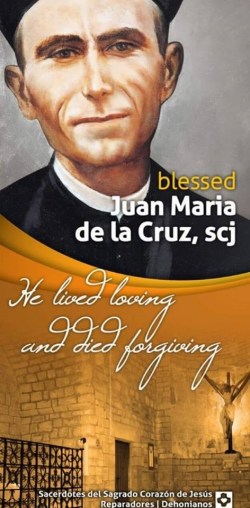
On September 22 we remember and celebrate the life of Fr. Juan Maria de la Cruz. On March 11, 2001, Pope John Paul II declared him blessed along with other 232 martyrs of the Spanish Civil War.
Mariano García Méndez was born on September 25, 1891, in San Esteban de los Patos in the Province of Avila. He was the firstborn of 15 children.
His family looked after the local church. Because there was no priest in the small community, his father, after a day of working in the fields, led novenas and rosary prayers. It came as no surprise when the father’s eldest, the boy called Marianito, felt called to the priesthood at the age of 10.
He eventually pursued that call and was ordained a priest for the diocese of Avila. Fr. Juan Maria served in parish ministry and later as a school chaplain.
Before diocesan ordination, Fr. Juan Maria discerned a vocation with the Dominican Fathers of Saint Thomas of Avila but health concerns prevented him from completing his novitiate. After ordination, he continued to feel called to religious life and sought entrance into the Christian Brothers in Nanclares de Oca, but again, his health failed him.
Continuing to serve as a diocesan priest, Fr. Juan Maria often found himself in Madrid, where he went to the church of the Religiosas Reparadoras (Sisters of Reparation). During one such visit, he met Fr. William Zicke, one of the founding members of the Spanish Province. They struck up a friendship and Fr. Juan Maria told him of his desire for religious life. In turn, Fr. Zicke told him about the Priests of the Sacred Heart and its founder, Fr. Leo John Dehon.
In the Dehonians Fr. Juan Maria found what he had been searching for and on October 31, 1926, he made his first profession. He took the religious name by which he is now known: “Juan María de la Cruz.” The name honored his two great loves: Holy Mary and St. John of the Cross, who like himself was from Avila.
Initially, Fr. Juan María was a teacher in the minor seminary at Novelda. However, by 1929 he moved into fundraising to help support the Spanish Province. At that time, fundraising was barely a step up from begging. Fr. Juan María went from village to village seeking both funds and vocations for the congregation.
The Spanish Civil War
In the midst of the turbulent years of civil strife in Spain from 1931-36, the Catholic Church in Spain suffered one of the most difficult persecutions in its history. Churches, seminaries, rectories, monasteries and convents, were sacked and destroyed. Thirteen bishops, 4,184 priests, 2,365 religious brothers, 283 nuns and thousands of lay Catholics were killed.
On July 23, 1936, Fr. Juan traveled to Valencia seeking refuge with one of the congregation’s benefactors. To hide his identity as a priest he dressed in a large, secondhand jacket. The oversized garment eventually earned him the nickname “Fr. Chaquet” (Fr. Big-Jacket).
Walking from the train station he passed the church of “los Santos Juanes” in the center of the city. There he witnessed men desecrating and burning the church. Fr. Juan shouted in protest. When the men heard his shouting, they said to each other: “He is a reactionary.”
“No, I am a priest!” said Fr. Juan.
That was all that was needed to arrest him and take him to the Modelo jail in Valencia.
In jail, witnesses recalled that Fr. Juan María remained faithful to his religious call.
A fellow prisoner remembers Fr. Juan standing in the prison courtyard, leading the rosary in a loud voice “and since we were always being watched by armed guards who insulted us and threatened us, someone asked him not to pray so as not to provoke them. But he said that nothing could have been better than to die praying, and so we continued with our prayers…”
“I remember having seen him every day in the prison yard praying with his breviary for at least an hour or an hour-and-a-half. He was seen praying so often that somebody said: ‘One day Fr. Chaquet will be shot down like a baby bird.’”
And another witness of those days said:
“He carried out his ministry with those who asked for it. He encouraged the people but did so in combination with a moderation which was an inherent characteristic of his priestly character. It can absolutely be said that he never made one gesture which could be considered as being insolent, it was rather quite the contrary.”
Fr. Juan’s cellmate said that “He always behaved like a completely worthy priest. If he found himself in the yard and heard the hours rung he recited prayers with whomever happened to be there. There were some who saw him doing that on several occasions. There were also times when I myself saw him praying in the cell. I never saw him behave discourteously with anyone.”
On the night of August 23, 1936, Fr. Juan, together with nine other prisoners, was taken south of Valencia to be shot. The next day the bodies of the victims were thrown into a common grave in the cemetery of Silla.
Fr. Juan María de la Cruz was the first Dehonian to be named blessed by the Church.
N.B. For English translation, please turn on subtitles

 On December 8, 2018, the Immaculate Conception Parish in Aluba, Cagayan de Oro City, celebrated its Patronal Feast of Immaculate Conception. The concelebrated Mass was presided by Fr. Bon Genson, SSJV, first diocesan priest who comes from this parish.


 The new general administration, together with the community of the general house in Rome, and other Dehonians who were present, met the Holy Father, Pope Francis, during the general audience on Wednesday, November 28, 2018, at the Paul VI Audience Hall.


 On November 26, 2018, members of the three SCJ communities in Cagayan de Oro area, together with the Dehonian Youth, Lay Dehonians and friends, celebrated the SCJ Memorial Day. The celebration was held at the Sacred Heart Formation House and was presided by Fr. Joseph Butlig, SCJ, who on this day celebrated his fifth anniversary of ordination to the priesthood.


 The Spanish Civil War
