Homily of His Holiness Pope Francis

AP2716033_LancioGrandeFeast of the Presentation of the Lord

2 February 2015

Before our eyes we can picture Mother Mary as she walks, carrying the Baby Jesus in her arms.  She brings him to the Temple; she presents him to the people; she brings him to meet his people.

The arms of Mother Mary are like the “ladder” on which the Son of God comes down to us, the ladder of God’s condescension.  This is what we heard in the first reading, from the Letter to the Hebrews: Christ became “like his brothers and sisters in every respect, so that he might be a merciful and faithful high priest” (Heb 2:17).  This is the twofold path taken by Jesus: hedescended, he became like us, in order then to ascend with us to the Father, making us like himself.

In our heart we can contemplate this double movement by imagining the Gospel scene of Mary who enters the Temple holding the Child in her arms.  The Mother walks, yet it is the Child who goes before her.  She carries him, yet he is leading her along the path of the God who comes to us so that we might go to him.

Jesus walked the same path as we do, and showed us a new way, the “new and living way” (cf. Heb 10:20) which is himself. For us too, as consecrated men and women, he opened a path.

Fully five times the Gospel speaks to us of Mary and Joseph’s obedience to the “law of the Lord” (cf. Lk 2:22-24,27,39).  Jesus came not to do his own will, but the will of the Father. This way, he tells us, was his “food” (cf. Jn 4:34). In the same way, all those who follow Jesus must set out on the path of obedience, imitating as it were the Lord’s “condescension” by humbling themselves and making their own the will of the Father, even to self-emptying and abasement (cf. Phil 2:7-8). For a religious person, to progress is to lower oneself in service. A path like that of Jesus, who “did not count equality with God something to be grasped.”: to lower oneself, making oneself a servant, in order to serve.

This path, then, takes the form of the rule, marked by the charism of the founder.  For all of us, the essential rule remains the Gospel, this abasement of Christ, yet the Holy Spirit, in his infinite creativity, also gives it expression in the various rules of the consecrated life, though all of these are born of that sequela Christi, from this path of self-abasement in service.

Through this “law” consecrated persons are able to attain wisdom, which is not an abstract attitude, but a work and a gift of the Holy Spirit, the sign and proof of which is joy. Yes, the mirth of the religious is a consequence of this journey of abasement with Jesus: and when we are sad, it would do us well to ask how we are living this kenotic dimension.

In the account of Jesus’ Presentation, wisdom is represented by two elderly persons, Simeon and Anna: persons docile to the Holy Spirit (He is named 4 times), led by him, inspired by him.  The Lord granted them wisdom as the fruit of a long journey along the path of obedience to his law, an obedience which likewise humbles and abases – even as it also guards and guarantees hope – and now they are creative, for they are filled with the Holy Spirit.  They even enact a kind of liturgy around the Child as he comes to the Temple.  Simeon praises the Lord and Anna “proclaims” salvation (cf. Lk 2:28-32,38).  As with Mary, the elderly man holds the Child, but in fact it is the Child who guides the elderly man. The liturgy of First Vespers of today’s feast puts this clearly and concisely: “senex puerum portabat, puer autem senem regebat”.  Mary, the young mother, and Simeon, the kindly old man, hold the Child in their arms, yet it is the Child himself who guides both of them.

It is curious: here it is not young people who are creative: the young, like Mary and Joseph, follow the law of the Lord, the path of obedience.  And the Lord turns obedience into wisdomby the working of his Holy Spirit.  At times God can grant the gift of wisdom to a young person, but always as the fruit of obedience and docility to the Spirit. This obedience and docility is not something theoretical; it too is subject to the economy of the incarnation of the Word: docility and obedience to a founder, docility and obedience to a specific rule, docility and obedience to one’s superior, docility and obedience to the Church. It is always docility and obedience in the concrete.

In persevering along along the path of obedience, personal and communal wisdom matures, and thus it also becomes possible to adapt rules to the times.  For true “aggiornamento” is the fruit of wisdom forged in docility and obedience.

The strengthening and renewal of consecrated life are the result of great love for the rule, and also the ability to look to and heed the elders of one’s congregation.  In this way, the “deposit”, the charism of each religious family, is preserved by obedience and by wisdom, working together. And, along this journey, we are preserved from living our consecration lightly and in a disincarnate manner, as though it were a Gnosis, which would reduce itself to a “caricature” of the religious life, in which is realized a sequela – a following – that is without sacrifice, a prayer that is without encounter, a fraternal life that is without communion, an obedience without trust, a charity without transcendence.

Today we too, like Mary and Simeon, want to take Jesus into our arms, to bring him to his people. Surely we will be able to do so if we enter into the mystery in which Jesus himself is our guide.  Let us bring others to Jesus, but let us also allow ourselves to be led by him.  This is what we should be: guides who themselves are guided.

May the Lord, through the intercession of Mary our Mother, Saint Joseph and Saints Simeon and Anna, grant to all of us what we sought in today’s opening prayer: to “be presented [to him] fully renewed in spirit”.  Amen.

(from Vatican Radio)

By scjphil Posted in Church

Anniversary of Religious Profession

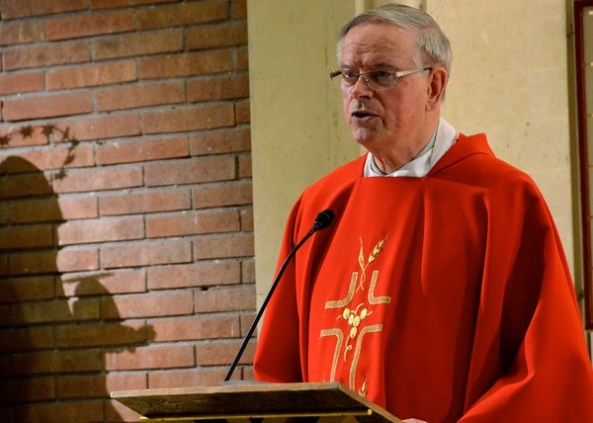
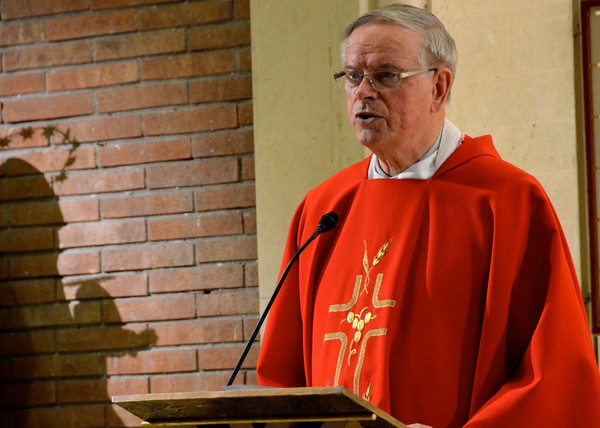
Today, on the Feast of the Presentation of the Lord and XIX World Day of Consecrated Life, Fr. Aloisio Back, the Master of Postulants, celebrated his 42nd Anniversary of First Profession of Vows. During his homily, recalling this very important in his life moment, he thanked God for all the graces and blessings that he has received. He also explained briefly the meaning of the three religious vows: poverty, chastity and obedience and of community life. The message coming from the heart and based on the life experience was a great testimony to what the religious life is about,

Today also is the anniversary of First Profession of Most Rev. Vilsom Basso, the bishop of Marañhao in Brazil, and Fr. Jose Benedito de Moreas Machado, who at the present is serving the Christian Community in Toronto, Canada. As we congratulate the three of them, we support them and their apostolates with our prayers.

PHILIPPINES – INDONESIA DEHONIAN FAMILY MEETING

Last January 31 to February 1, 2015, delegates from Indonesia came to the Philippines for a meeting to discuss the implementation of the Spiritual Path (Iter Formativo). The encounter took place in the Sacred Heart Formation House, Cagayan de Oro City.  With the blessing and support of Fr Andreas Madya and Fr Franciszek Pupkowski, respective Superiors of the Indonesian Province and Philippine Region, the group gathered to make a strategic plan of action regarding the development of the Dehonian Family in the Asian continent.  Grace Escobia, who is a member of the interim International Coordinating Group of the Dehonian Family whose area of responsibility is Asia, coordinated the encounter.

The gathering was participated by Fr. Agustinus Setyoaji, Fr. Anselmus Inharjanto, Fr. Aloysius Yudhistiro and Mr. Philippus Harijadi from Indonesia and Marian Cabarliza, Lovely Monique Nanol, Joan Palapar and Fr. Richie Gier from the Philippines.

The meeting started with the input about the Charter of Communion of the Dehonian Family.  This was followed by the sharing of the message regarding the international encounter in May 2014 in Rome.  Afterwards there was a presentation from the respective countries of the state of affairs in their distinct realities about the situation of the Dehonian Family, specifically, the laity and youth group. It was observed that both countries thus far have an active youth group while the laity is still a work in progress.  The presence of consecrated persons in Indonesia, specifically, the Compania Missionaria, was recognized and integrated in the planning.  Each entity of the Dehonian family was essentially encompassed including the Dehonian Youth.

In the morning of February 1, 2015, brainstorming and discussion ensued about the integral plan of action for the development of the laity and consecrated persons in the Asian continent vis-à-vis the implementation of the Iter Formativo in the context of the program outlined by the International Coordinating Group for 2015 to 2017.  The participants were able to devise a plan within the given period for the growth of the Dehonian Family in Indonesia and the Philippines. It was also decided, in the perspective of Sint Unum, to invite delegates from India and Vietnam as observers in the next continental coordinating group meeting for Asia tentatively scheduled in January 2016.

The encounter was concluded by a Eucharistic Celebration concelebrated by the Indonesian Dehonian fathers headed by Fr. Agustinus Setyoaji. A number of Lay Dehonians from Cagayan de Oro joined the mass.  The group was enriched by the beautiful sharing of experiences on how the Dehonian Spirituality is lived out in the respective countries, the exchange of ideas and resources for development and formation, as well as looking forward to another encounter in 2016 which is planned to be held in Vietnam.

What was most striking was the teaching on LoReSa as imparted by the Indonesian fathers… love, readiness and sacrifice. The witnessing of Ecce venio and Ecce ancilla. Indeed, as Dehonians we are called to love, to readiness (availability) and to sacrifice – that the Kingdom of the Heart of Christ may reign. Adveniat regnum tuum.

By: Atty Grace Escobia

Sharing of Experiences

Fr. John Czyzynski, SCJ, a retired Novice Master from the U.S, Province is on his visit in the Philippines. The main purpose of his visit is to share his experience as a formator with the formators of the Philippine Region. The majority of the formators in the Philippines are young and lack of experience, but on the other hand very much willing to learn from their older brother.

The meeting with Fr. John took place in Cagayan de Oro City at the Sacred Heart Formation House from January 19 – 21, 2015 and was attended by eight formators representing all the stages of formation. Besides the sharing of personal experiences on both sides, there were many practical questions on how to do the formation in the time of constant changes in the world,and of mentality, how to deal with the issues of proper use of the internet, social networks, etc., that sometimes disturb the formation process.

The meeting was very much appreciated by the formators and gave them many insights that can be helpful in their work. Sometimes life experience is more valuable than series of lectures.

Qutations from Pope Francis

PopespeakSelected quotations from Pope Francis’ spontaneous remarks during his meeting with the youth at University of Santo Tomas on Sunday:

— “Real love is being open to the love that comes to you, the love that surprises us. If you only have information you are not surprised. Love surprises because it opens a dialogue of loving and being loved.”

— “Allow yourselves to be surprised by God. Don’t be afraid of surprises. They shake the ground beneath our feet and make us insecure, but they move us forward in the right direction.”

— “Certain realities of life we only see through eyes cleansed by our tears. I invite each one here to ask yourself: Have I learned how to weep?”

— “If you don’t learn how to cry, you cannot be a good Christian.”

— “We have so much information but maybe we don’t know what to do with that information. So we run the risk of becoming museums of young people who have everything but not knowing what to do with it.”

— “For this the Gospel offers us a serene way forward: using the three languages of the mind, heart and hands—and to use them in harmony. What you think, you must feel and put into effect. Your information comes down to your heart and you put it into practice. Harmoniously. What you think, you feel and you do. Feel what you think and feel what you do. Do what you think and what you feel.”

— “Real love is about loving and letting yourself be loved. It’s harder to let yourself be loved than to love.”

— “To be wise use three languages: Think well, feel well and do well. And to be wise allow yourselves to be surprised by the love of God. That will guarantee a good life.”

— “Let us not have a computer psychology that makes us think we know it all. All answers on computers—but no surprises.”

— “How many young people among you are like this? You know how to give and yet you have ever learned how to receive? You still lack one thing. Become a beggar. This is what you still lack. Learn how to beg. This isn’t easy to understand. To learn how to beg. To learn how to receive with humility. To learn to be evangelized by the poor, by those we help, the sick, orphans—they have so much to give us.”

— “Do you think of the poor? Do you feel with the poor? Do you do something for the poor? Do you ask the poor to give you the wisdom they have?”

Selected quotes from homily at Quirino Grandstand:

— “Today, Saint Paul has told us that in Christ we have become God’s adopted children—brothers and sisters in Christ. This is who we are. This is our identity.”

— “Filipinos are called to be outstanding missionaries of the faith in Asia.”

— “We forget to remain focused on the things that really matter. We forget to remain, at heart, children of God. That is sin: [to] forget at heart that we are children of God.”

— “We too need to protect, guide and encourage our young people, helping them to build a society worthy of their great spiritual and cultural heritage. Specifically, we need to see each child as a gift to be welcomed, cherished and protected. And we need to care for our young people, not allowing them to be robbed of hope and condemned to life on the streets.”

— “Now, at the end of my visit to the Philippines, I commend you to Him, to Jesus who came among us as a child. May he enable all the beloved people of this country to work together, protecting one another, beginning with your families and communities, in building a world of justice, integrity and peace.”

— “May the Santo Niño continue to bless the Philippines and may he sustain the Christians of this great nation in their vocation to be witnesses and missionaries of the joy of the Gospel in Asia and in the whole world.”

— “Reality is superior to ideas.”

Source: Philippine Inquirer