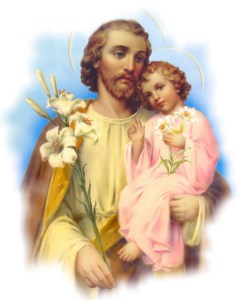
 St. Joseph is not only the Saint Patron of the Universal Church, but also one of main patrons of the Congregation of the Priests of the Sacred Heart of Jesus (SCJ) and a Saint Patron of Kasanag Daughters Foundation, Inc. (KDFI). Each year, on March 19, the foundation holds a special celebration, which starts with the Holy Eucharist and ends with a simple meal. As usual, the celebration is attended by beneficiaries of the foundation, staff, board members, former daughters, benefactors, SCJ priests and friends. The purpose of this is to honor their patron and thank him for his protection and guidance.
This year the main celebrant was Fr. Joseph C. Butlig, SCJ, the KDFI coordinator, who at the same time celebrated the feast of his Patron Saint.
St. Joseph, the spouse of the Blessed Virgin Mary and the foster-father of Jesus, was probably born in Bethlehem and probably died in Nazareth. His important mission in God’s plan of salvation was “to legally insert Jesus Christ into the line of David from whom, according to the prophets, the Messiah would be born, and to act as his father and guardian” (Directory on Popular Piety and the Liturgy). Most of our information about St. Joseph comes from the opening two chapters of St. Matthew’s Gospel. No words of his are recorded in the Gospels; he was the “silent” man. We find no devotion to St. Joseph in the early Church. It was the will of God that the Virgin Birth of Our Lord be first firmly impressed upon the minds of the faithful. He was later venerated by the great saints of the Middle Ages. Pius IX (1870) declared him patron and protector of the universal family of the Church.
St. Joseph was an ordinary manual laborer although descended from the royal house of David. In the designs of Providence he was destined to become the spouse of the Mother of God. His high privilege is expressed in a single phrase, “Foster-father of Jesus.” About him Sacred Scripture has little more to say than that he was a just man-an expression which indicates how faithfully he fulfilled his high trust of protecting and guarding God’s greatest treasures upon earth, Jesus and Mary.
The darkest hours of his life may well have been those when he first learned of Mary’s pregnancy; but precisely in this time of trial Joseph showed himself great. His suffering, which likewise formed a part of the work of the redemption, was not without great providential import: Joseph was to be, for all times, the trustworthy witness of the Messiah’s virgin birth. After this, he modestly retires into the background of holy Scripture.
Of St. Joseph’s death the Bible tells us nothing. There are indications, however, that he died before the beginning of Christ’s public life. His was the most beautiful death that one could have, in the arms of Jesus and Mary. Humbly and unknown, he passed his years at Nazareth, silent and almost forgotten he remained in the background through centuries of Church history. Only in more recent times has he been accorded greater honor. Liturgical veneration of St. Joseph began in the fifteenth century, fostered by Sts. Brigid of Sweden and Bernadine of Siena. St. Teresa, too, did much to further his cult.
At present there are two major feasts in his honor. On March 19 our veneration is directed to him personally and to his part in the work of redemption, while on May 1 we honor him as the patron of workmen throughout the world and as our guide in the difficult matter of establishing equitable norms regarding obligations and rights in the social order.
—Excerpted from The Church’s Year of Grace, Pius Parsch
St. Joseph is invoked as patron for many causes. He is the patron of the Universal Church. He is the patron of the dying because Jesus and Mary were at his death-bed. He is also the patron of fathers, of carpenters, and of social justice. Many religious orders and communities are placed under his patronage.
Patron: Against doubt; against hesitation; Americas; Austria; Diocese of Baton Rouge, Louisiana; California; Belgium; Bohemia; bursars; cabinetmakers; Canada; Carinthia; carpenters; China; confectioners; craftsmen; Croatian people (in 1687 by decree of the Croatian parliament) dying people; emigrants; engineers; expectant mothers; families; fathers; Florence, Italy; happy death; holy death; house hunters; immigrants; interior souls; Korea; laborers; Diocese of La Crosse, Wisconsin; Archdiocese of Louisville, Kentucky; Diocese of Manchester, New Hampshire; Mexico; Diocese of Nashville, Tennessee; New France; New World; Oblates of Saint Joseph; people in doubt; people who fight Communism; Peru; pioneers; protection of the Church; Diocese of San Jose, California; diocese of Sioux Falls, South Dakota; social justice; Styria, Austria; travelers; Turin Italy; Tyrol Austria; unborn children Universal Church; Vatican II; Vietnam; Diocese of Wheeling-Charleston West Virginia; wheelwrights; workers; working people.
Symbols: Bible; branch; carpenter’s square; carpenter’s tools; chalice; cross; hand tools; infant Jesus; ladder; lamb; lily; monstrance; old man holding a lily and a carpenter’s tool such as a square; old man holding the infant Jesus; plane; rod.
Source: https://www.catholicculture.org/culture/liturgicalyear/calendar/day.cfm?date=2019-03-19

Prayer to Joseph,
Who is Known by Many Titles
Faithful Joseph:
Teach us to listen and not be afraid to trust
as you did in God’s promise.
Loving Joseph:
Teach us to love courageously with a heart
that is free and just.
Protector Joseph:
Teach us to protect one another and all
that belongs to God.
Dreamer Joseph:
Teach us to dream a world where all are neighbors;
a vision illuminated by God’s light.
Teacher Joseph:
Teach us to keep the Word of God close to our hearts, and to proclaim it in word and action.
Gentle Joseph:
Teach us to be gentle with our power and
strong in our tenderness.
Parent Joseph:
Teach us to be for all persons a living lesson
of goodness and truth – a blessing for all
generations to come.
Amen.
 On May 13, 2019, the parish community of the Holy Cross Parish (Parokya ng Banal na Krus) in Tandang Kutyo, Tanay, Rizal (Diocese of Antipolo) celebrated its feast. The celebration started with a procession of the faithful and the Holy Cross at 6:00 am and was followed by the groundbreaking ceremony of the new convent (priests’ residence) at 8:30 am presided by Fr. Manny Cuevas with the presence of some guest priests from the vicariate of San Ildefonso, Parish Pastoral Council and Parish Finance Council members, architect and parishioners. After the blessing, the Holy Mass was celebrated.


 On April 10, 2019, two SCJ confreres on temporary vows, Bro. Victor Lingasa and Bro. Julius Socorro, made their final commitment to God in the Congregation of the Priests of the Sacred Heart of Jesus (SCJ). The ceremony was held in the under construction new church of Quasi Parish Medalla Milagrosa in Talisay, Hilongos, Leyte and was preceded by the SCJ regular meeting a day before. The concelebrated Mass was presided by His Excellency Most Rev. Precioso D. Cantilias, SDB, DD, the Bishop of Maasin Diocese. In his homily, the bishop welcomed all the SCJs and expressed his wish to have another SCJ presence in his diocese.


 Forty (40) years ago on February 21, 1979, Fr. Yohanes Sono Pribadi, SCJ, member of the SCJ Philippine Region, was ordained priest. The ceremony of ordination took place in Metro, Lampung Tengah, Indonesia, his native place and was officiated by the Most Rev. Albert Hermelink Gentiaras, SCJ, Dutch, Bishop of Tanjungkarang. It should be noted that he was ordained as a diocesan priest for the Diocese of Lampung. However, knowing many SCJ priests, Fr. Yohanes had enough opportunities to learn about their charism and spirituality. Besides, the devotion to the Sacred Heart of Jesus was embedded in him by his father, a great devotee of God’s Heart. These all helped him to decide entering the Congregation.


