
From the left: Fr. Jeremiah Sheehy, Fr. Henricus Sondermeijer, Fr. Yohanes Sono Pribadi, Fr. Stephen Schmitz, Fr. Adrian Borst – General Councilor, Pope John Paul II, Fr. Francis Pupkowski, Fr. Eduardo Aguero, Fr. Juan Domingo Griffone and Fr. Rino Venturin.
May 17, 1989, is the official date of arrival of first SCJ missionaries in the Philippines. The original group was composed of eight (8) priests representing seven (7) nationalities and five (5) different entities: 3 from Argentina, 2 from Indonesia, 1 from Germany, 1 from Poland and 1 from British-Irish Province.
Prior to that, from October 1988 to March 1989, the group met in the United States, in Hales Corners (WI) to study English, the common language of the group and one of the official languages in the Philippines.
From April 20 – May 3, 1989, the whole group met again in Rome. During series of meetings with the members of the General Administration, different people from the Philippines, the group could learn more about the needs and challenges lying ahead of them. On April 25, 1989, the group of first missionaries came up with the following guiding principles for their new mission:
- As a SCJ group of missionaries we give the highest priority to Community life. We reaffirm that “Community life is mission itself”.
- We go to the Philippines to serve the local Church, as communities, according to the missionary spirit of our own Rule of life.
- We will try to stay together and to live together avoiding situations where a member has to live permanently alone.
- We intent normally to form communities of at least three members.
- We are going to share life, responsibilities, pastoral work, projects and money.
- We are going to meet once a month with the whole group for at least one day.
- We are going to meet, once a year, for an Assembly and also in a different date for a Retreat.
- Once a week those who live nearby are invited to come together.
- While we are a small group, we will share all responsibilities and decisions.
- There will be a single common money box; there will be neither funds nor private projects. All decisions, on projects, will be taken together by the missionary group.
The group also chose a coordinator, two councilors and a treasurer.
On April 26, 1989, the group was received by Pope St. John Paul II, who gave his apostolic blessing to the new missionaries, after the mass celebrated in his private chapel at the Vatican City, before their departure for Asia.
As usual, at the end of the Mass celebration, the group was guided from the Pope’s Chapel to the library nearby, where the Holy Father greeted his guests.
“When the Secretary of the Pope told him about us, the Holy Father smiling said to us ‘Dehonians, Dehonians, courage in the Philippines’ (Fr. Juan Domingo Griffone).

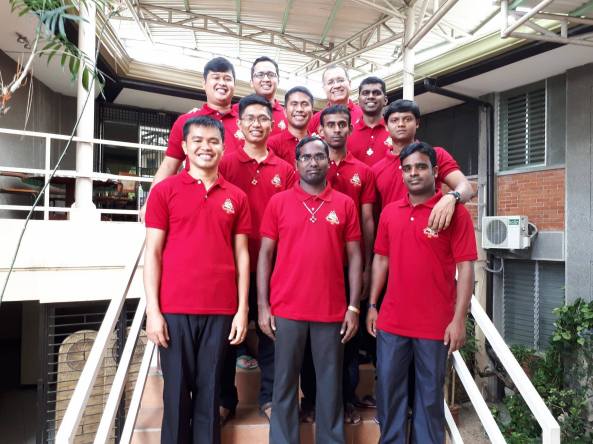 From June 4 – 30, 2017, nine scholastics from the Asian Zone (India -5, Indonesia – 2, Philippines – 2) take part in Final Vows Preparation in Manila. The four week activities encompass the following topics: Dehonian perspective of the Religious Vows by Fr. Yudhistiro Adi Fritri Tyassanto, scj from Indonesia, Apostolic and Social dimension of the Dehonian Religious by Fr. Nino Etulle, scj from the Philippines and Affective maturity and Religious Life by Fr. Michael Agustin Moses from India. As usual the activities will end with five day Spiritual Retreat (June 25 – 29) conducted by Fr. Delio Ruiz,SCJ, who is in charge of the whole preparation. The participants had an opportunity to visit the three parishes run by SCJs in Metro Manila: San Lorenzo Ruiz Parish in Quezon City, San Roque Parish in Bagong Silang and Holy Cross Parish in Tanay.


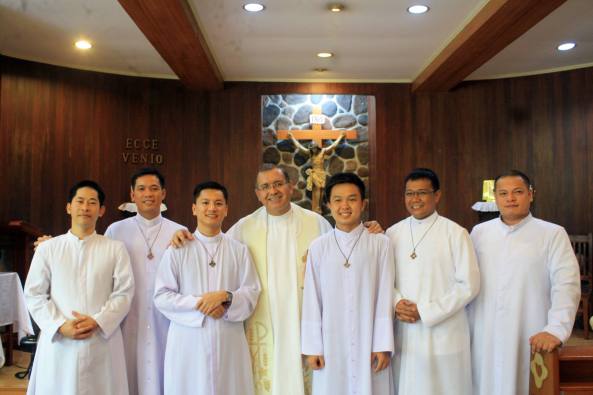 On June 16, 2017, six SCJs on temporary vows (2 Filipinos and 4 Vietnamese) renewed their vows of Chastity, Poverty and Obedience in the Congregation of the Priests of the Sacred Heart of Jesus. The Eucharistic Celebration was presided by Rev. Fr. Aloisio Back. SCJ, the Vice-superior of the SCJ Philippine Region, and was attended by the SCJs from the nearby communities, scholastics from India and Indonesia – participants of the final vows preparation program and some friends.


 On May 27, 2017, the Kasanag Daughters Foundation, Inc. (KDFI), one of the social projects of the Priests of the Sacred Heart – Philippine Region in Cagayan de Oro City, celebrated its 18th Founding Anniversary. The celebration started with the Holy Eucharist presided by Fr. Donald Longno, SCJ, and was followed by the arts exhibit prepared by the girls, very short cultural presentation and common supper. The institution, providing shelter and rehabilitation opportunities to the victims of sexual abuse, was established in 1999 by Fr. Eduardo Aguero, SCJ. As of now, the institution takes care of 24 girls, aged 7 to 16 years. The project coordinator is Fr. Joseph Butlig, SCJ. Since the beginning, the total number of admittances reached 190.


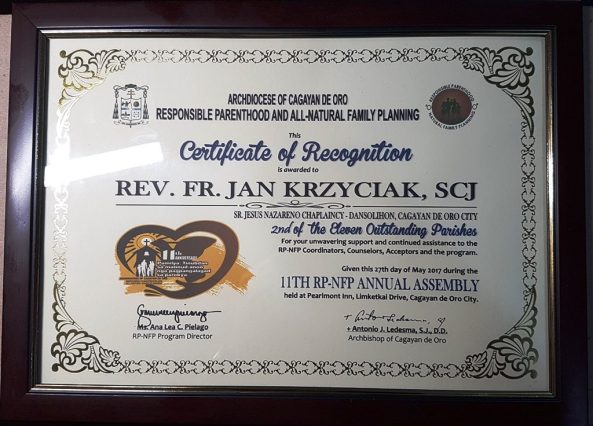 On May 27, 2017, Fr. Jan Krzysciak. SCJ, the pastor in charge of Jesus Nazareno Chaplaincy in Dansolihon, received a “Certififate of Recognition” from the the “Responsible Parenthood and All-Natural Family Planning” of the Archdiocese of Cagayan de Oro. The Chaplaincy in Dansolihon was ranked as the second of the eleven outstanding parishes for the unwavering support and continued assistance to the RP-NFP Coordinators, Counselors, Acceptors and the Program. The certificate is signed by the Archbishop of Cagayan de Oro, Most. Rev. Antonio J. Ledesma, S.J., D.D.
